QR code minimum size: how small you can print it
For a short link held in the hand, print it at least 20 mm (0.79 in) square, blank border included, and never under 15 mm. A long link, a logo or a longer scanning distance needs more; the calculator below works out yours and gives you a link to the answer.
20 cm ÷ 10 = 20 mm
Print it at least
20 mm
(0.79 in) square
Set by the distance. The squares would allow 15 mm, so there is room to spare.
Shown at print size
20 mm
On screen this is only as accurate as your display. Print this page at 100% and measure it: at 20 mm it should match a ruler, and if it does not, the artwork was scaled somewhere.
Print at 100%. In the print dialog choose “Actual size”, not “Fit to page”, and don’t let anyone crop the blank margin: the 20 mm includes it.
This is a sample to size by. To make your own code, use the free generator, then print it at 20 mm.
Make your codeThe working
- Distance20 cm ÷ 10 = 20 mm
- Squares(25 + 4 + 4 margin) × 0.4 mm = 13.2 mm
- Floor15 mm
The largest of the three wins, rounded up to the next half millimetre: 20 mm.
- Symbol version
- 2 — 25 × 25 squares
- Error correction
- Medium
- One square at that size
- 0.61 mm
- Blank margin (quiet zone)
- 2.4 mm on every side
- The pattern alone
- 15.2 mm
- In inches, rounded up
- 7/8 in
- Size in mm and inches
- Uses the real square count
- Logo and long links included
- Free, no account
On this page
QR code dimensions from a sticker to a billboard
For a short link or a long web address, what the code holds matters only up close. From 30 cm away the four columns agree, and the distance alone sets the size.
| Printed on, read from | Short link26 characters | Long address115 characters | ||
|---|---|---|---|---|
| No logo | Logo | No logo | Logo | |
| Label or sticker15 cm | 15 mm5/8 in | 20 mm7/8 in | 21.5 mm7/8 in | 26 mm1 1/8 in |
| Business card20 cm | 20 mm7/8 in | 20 mm7/8 in | 21.5 mm7/8 in | 26 mm1 1/8 in |
| Flyer or leaflet30 cm | 30 mm1 1/4 inall four the same | |||
| Table card or menu40 cm | 40 mm1 5/8 in | |||
| A4 or Letter sign60 cm | 60 mm2 3/8 in | |||
| Poster1 m | 100 mm4 in | |||
| Poster2 m | 200 mm7 7/8 in | |||
| Poster3 m | 300 mm11 7/8 in | |||
| Banner or shop window5 m | 500 mm19 3/4 in | |||
| Billboard10 m | 1000 mm39 3/8 in | |||
Method: distance ÷ 10, never under 15 mm, and at least 0.4 mm per square; the largest wins. Those three limits are our cautious choices, not the QR standard’s.
Cite this table
- Suggested citation
- QRSalt. “Minimum QR code print sizes by use and scanning distance.” https://qrsalt.com/qr-code-size#reference-table. Last reviewed October 1, 2026.
- HTML link
<a href="https://qrsalt.com/qr-code-size#reference-table">Minimum QR code print sizes by use and scanning distance</a>
A short link makes a smaller code
A QR code is a grid of squares, and the more it holds, the more squares it needs. More squares at the same printed size means each one is smaller, and small squares are what phones miss.
| The code holds | Squares across | With a logo |
|---|---|---|
| Short link26 characters | 25 (version 2) | 41 (version 6) |
| Long web address115 characters | 45 (version 7) | 57 (version 10) |
| Contact card (vCard)193 characters | 57 (version 10) | 97 (version 20) |
Counted with Medium error correction, the generator’s default; the short link is a dynamic code’s own link, https://qrsalt.com/k7Rm2Qx. Each square needs 0.4 mm, so the squares set a size of their own: the long address needs 53 across, margin included, which is 21.2 mm before the distance is even asked. That only bites up close. A contact card bites harder: it needs 26 mm even held in the hand, and 42 mm with a logo.
So the cheapest way to make a code smaller is to make it hold less. A dynamic code always holds a short link and sends the scan on to the long address, however long that is. For a card, an editable contact code does the same for your details.
A logo needs the highest error correction, and more squares
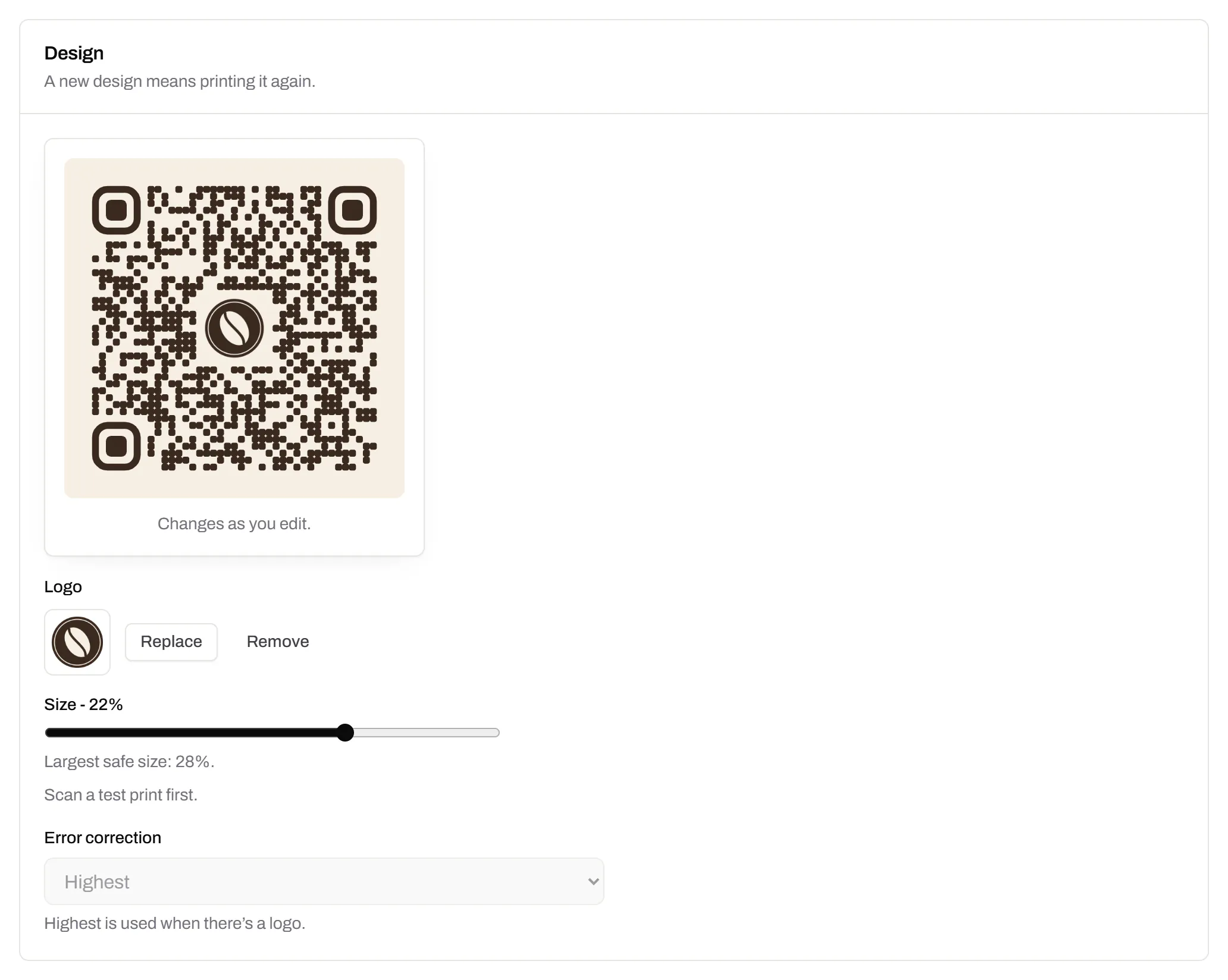
A logo covers part of the pattern, so the code has to carry enough spare data to rebuild what is hidden.
When you add a logo, our generator switches error correction to Highest, which can lose about 30% of the pattern and still scan. It also moves to a larger version when the smallest one has no room for a logo. That is why the short link grows from 25 to 41 squares across: version 2 becomes version 6.
Those extra squares cost nothing on a poster, where the distance asks for more anyway. In the hand they can decide the size, as the business-card row of the reference table shows. Turn on “A logo in the middle” in the calculator to see it for your own case.
The blank margin is part of the size
Phones find a QR code by the empty band around it. The QR standard asks for 4 squares of blank space on each side, and every size here already includes it.
On the 20 mm short-link code, the margin is 2.4 mm on each side and the pattern itself is 15.2 mm. If a designer trims the margin to make the code look tidy, or puts text or a photo right up to the pattern, phones struggle to find where the code starts.
The margin must be the same light colour as the code’s background. Our generator starts it at 4 squares, and the Quiet zone setting in the design panel widens it, which helps when the code sits on a busy background.
Millimetres or inches: round up, never down
The calculator gives millimetres, rounded up to the next half millimetre, and inches to two decimals. One inch is 25.4 mm.
Design software in the United States often works in fractions of an inch. When you convert, round up to the next eighth, never down: a 20 mm code is 0.79 in, and ¾ in is only 19.05 mm, which is smaller than the minimum.
| Minimum | Exactly | Ask for |
|---|---|---|
| 15 mm | 0.59 in | 5/8 in |
| 20 mm | 0.79 in | 7/8 in |
| 25 mm | 0.98 in | 1 in |
| 30 mm | 1.18 in | 1 1/4 in |
| 40 mm | 1.57 in | 1 5/8 in |
| 50 mm | 1.97 in | 2 in |
QR code size in pixels, for a screen
On a screen, as on paper, what decides whether a code scans is how big it looks from where the phone is. The number of pixels in the file matters much less.
The PNG from our generator is 1024 pixels wide, and the calculator above downloads one 2048 wide. The short-link code is 33 squares across with its margin, so each square gets 31 or 62 pixels. That is far more than a screen needs, so use the file as it is and set the size in your page or slide, rather than making a smaller file.
Choose the displayed size with the same distance rule as print. A code on a phone held in the hand needs about 20 mm of glass; a code on a television is sized like a poster read from the same spot. Hold a ruler to the screen once, because the same pixel width looks very different on a phone, a laptop and a television.
Where you can, give every square the same whole number of pixels. At 198 pixels wide, each of the 33 squares gets exactly 6 and every edge is sharp; at a round 200, each gets a fraction and the browser blurs the edges between them. New phones read the blurred one too, but an older phone or a laptop webcam is less forgiving. How many pixels a printer needs is on the SVG and PNG download page.
Test one print before the whole run
The numbers here are a safe starting point. A printed test on the real material is the only proof.
- Print the calculator’s preview, or your artwork, at 100%. Measure the code with a ruler; it should match the size you asked for, margin included.
- Scan it with two phones, one of them a few years old, from the distance people will really stand.
- Try it in the light where it will hang or sit, not only at your desk.
- If it needs more than one try, print it bigger or make the code hold less. Sharpening the image or raising the resolution won’t help.
Gloss, curves and texture need more
The sizes here assume a flat, matt, light surface. Glossy lamination, a curved bottle, textured card and fabric all make the camera’s job harder, so go one step bigger and test. Which papers and finishes scan best is covered on the flyer printing page, and packaging with its own calculator on the barcode generator.
Questions about print size
What is the smallest QR code a phone can read?
The smallest QR code has 21 squares across. How small it can be printed depends on the phone’s camera, the light and the printer, and some phones read codes under a centimetre in good light. We never size below 15 mm. That floor is our own cautious choice, not part of the QR standard.
Can I print a QR code smaller than 15 mm?
You can, at your own risk. Keep the link as short as possible, leave the logo off, print on smooth white stock with a laser or offset printer, and test the printed piece with two phones before the full run. Our 0.4 mm per square is on the safe side; a good printer holds finer detail, but you only find out by testing.
Does the size include the white border?
Yes. Every size on this page includes the blank margin of 4 squares on each side. If your layout places the code on a white area anyway, the margin can overlap that white, but nothing printed may come inside it.
Why does my code scan on screen but not on paper?
A screen lights the code from behind, is perfectly flat and is usually viewed larger than the print. On paper, ink spreads into the white gaps, gloss reflects light, and the code is often printed smaller than the proof because someone chose “Fit to page”. Measure the printed code with a ruler first; most failures are simply a code printed smaller than planned.
Is there a maximum QR code size?
Not for the printed size. An SVG has no pixels, so the same file scales to a banner or the side of a van, and the scanning distance tells you how big to go. The limit is on what it holds: the largest QR code the standard allows is version 40, 177 squares across, with room for 2,953 bytes. Long before that a code is too dense to scan comfortably from a normal size, which is why a short link beats a long address.
How big should a QR code be on a poster?
Size it for the furthest spot someone would stand and still want to scan, at a tenth of that distance: a poster read from 1.5 m needs 150 mm (5.91 in). The reference table on this page gives 1, 2 and 3 metres. On a poster the length of the link makes no difference.
Last reviewed , against the product as it works today.
The rest of the toolbox
Open a row to see the screen and which plan has it.
Print-ready downloads
PNG and SVG on every plan, and a PDF for the printer.PNG and SVG on every plan · PDF on Starter and up
PNG for screens and quick jobs, SVG for anything that gets scaled, and a print-ready PDF on Starter and up.
PNG and SVG on every plan · PDF on Starter and up
Your logo in the middle
Upload any image; we size it so the code still scans.Every plan, Free included
Upload a PNG, JPEG, WebP or GIF of up to 15 MB. We make it smaller ourselves, so you don’t have to compress it first. We raise the error correction to make room for the logo, and we never let the logo cover more of the code than the code can lose and still scan.
Every plan, Free included
Short links, with your own ending
The link on its own, for a bio, an email or an ad.Every plan · custom endings on Business
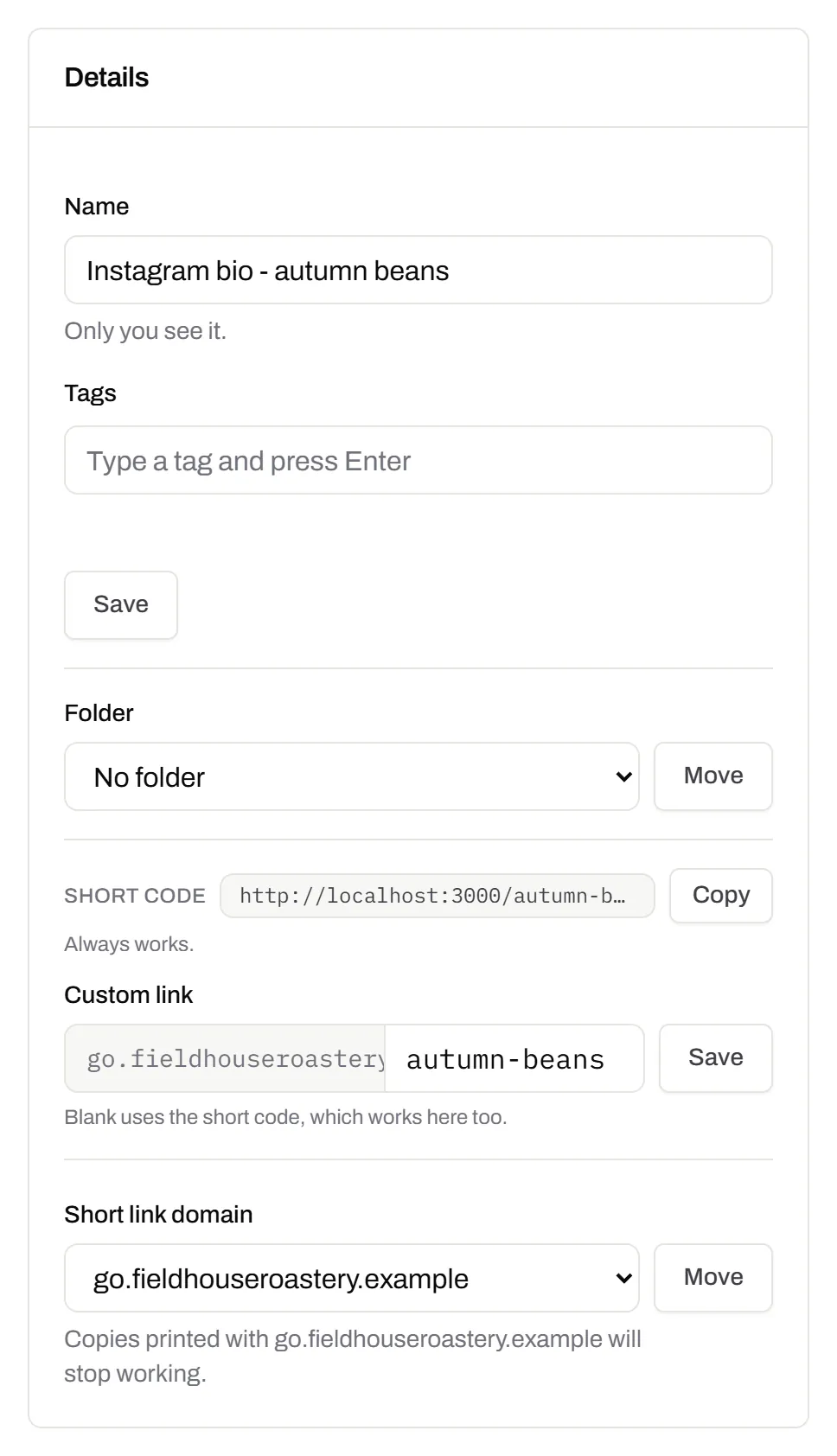
Paste a link and get a short one you can change, route and count, with no QR code unless you want one. Every dynamic code already has its short link beside it, and you can turn a short link into a QR code in one click. The code uses the same link, so clicks and scans are counted together. On Business you choose how the link ends, like /spring-menu, instead of random letters.
Every plan · custom endings on Business
The URL shortener