
Google Form QR code
Paste the form’s responder link and download a code for the sign, the handout or the last slide. Saved as a dynamic code, it can open next term’s form without a new print run, and it counts every scan on the way.
Dynamic & Editable
Change where it points after printing, and see who scans it.
Type a destination to download.
This is an example code. Style it now — yours takes its place as you type.
Design
Style
Colour#000000
Shapesquare
Body shape
Corner shape
Inside shape
Framelabel-below
Logonone
Print settingsECC M
Next term’s form, behind the same printed sign
A Google Form is usually replaced rather than edited: a fresh copy for the new intake, the next event, this year’s sign-up, each with its own link. Every poster and handout carrying the old link is wrong the moment that happens. Print a dynamic code instead and the paper outlives the form, because the address behind it is a two-minute edit.
One sign, a new form each round
Copy last year’s form, change the questions, and point the code at the copy. The sign on the noticeboard starts filling this year’s response sheet, and nobody has to re-tape anything.
Count who started, not only who finished
Google counts the answers it receives. The code counts the scans that led to them, day by day, so a sign nobody scans looks different from a form people open and abandon.
Close a form without a dead end
A closed form tells a scanner it is no longer accepting responses and leaves them there. Send the code to the results, the next date or a short note instead, the moment you stop collecting.
The code, the form, and the answers
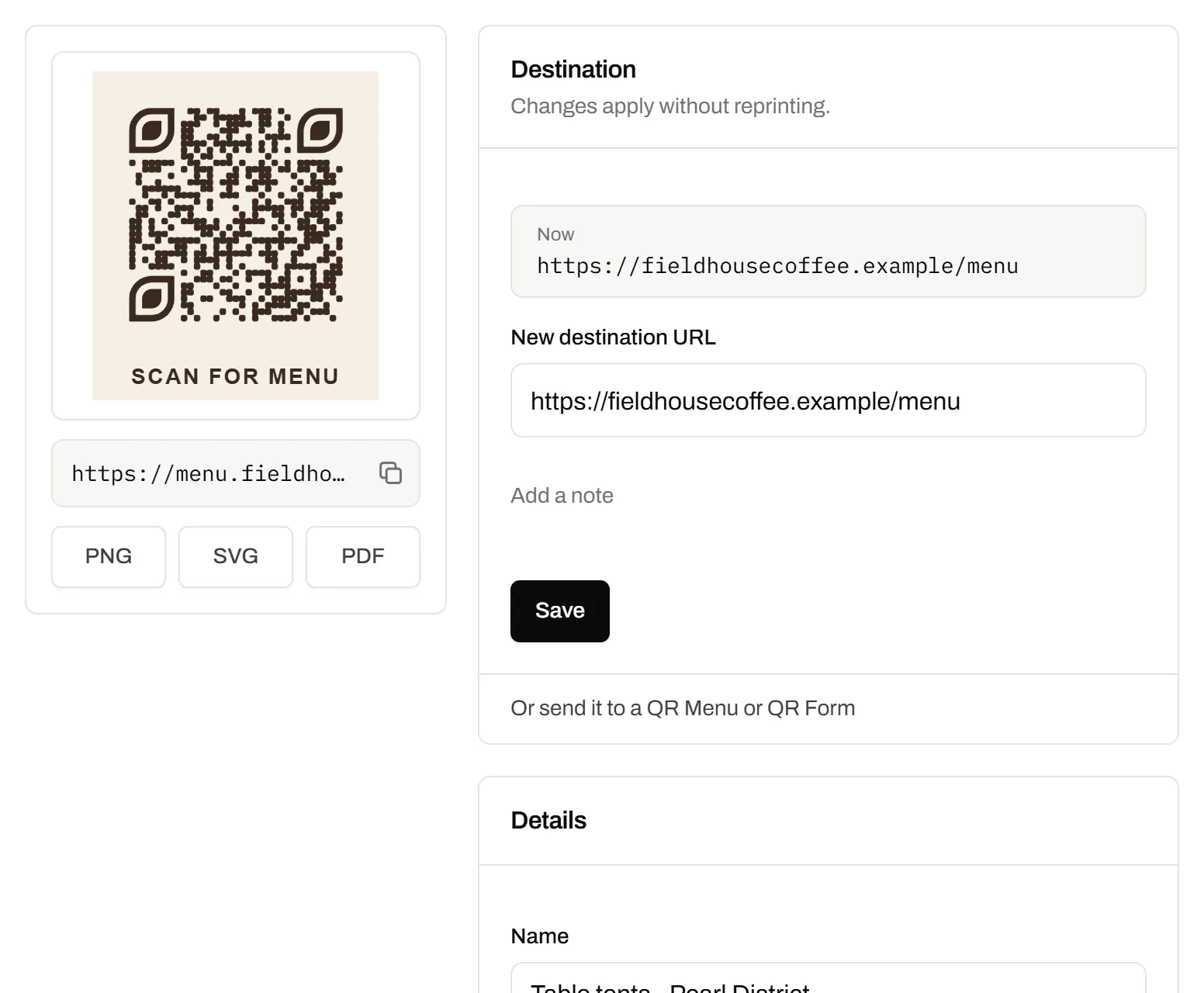
Change the form the sign opens, in one edit
Paste the new form’s link over the old one and save. Everything already printed points at the new form from the next scan, and the previous link stays in the history in case you swap back.
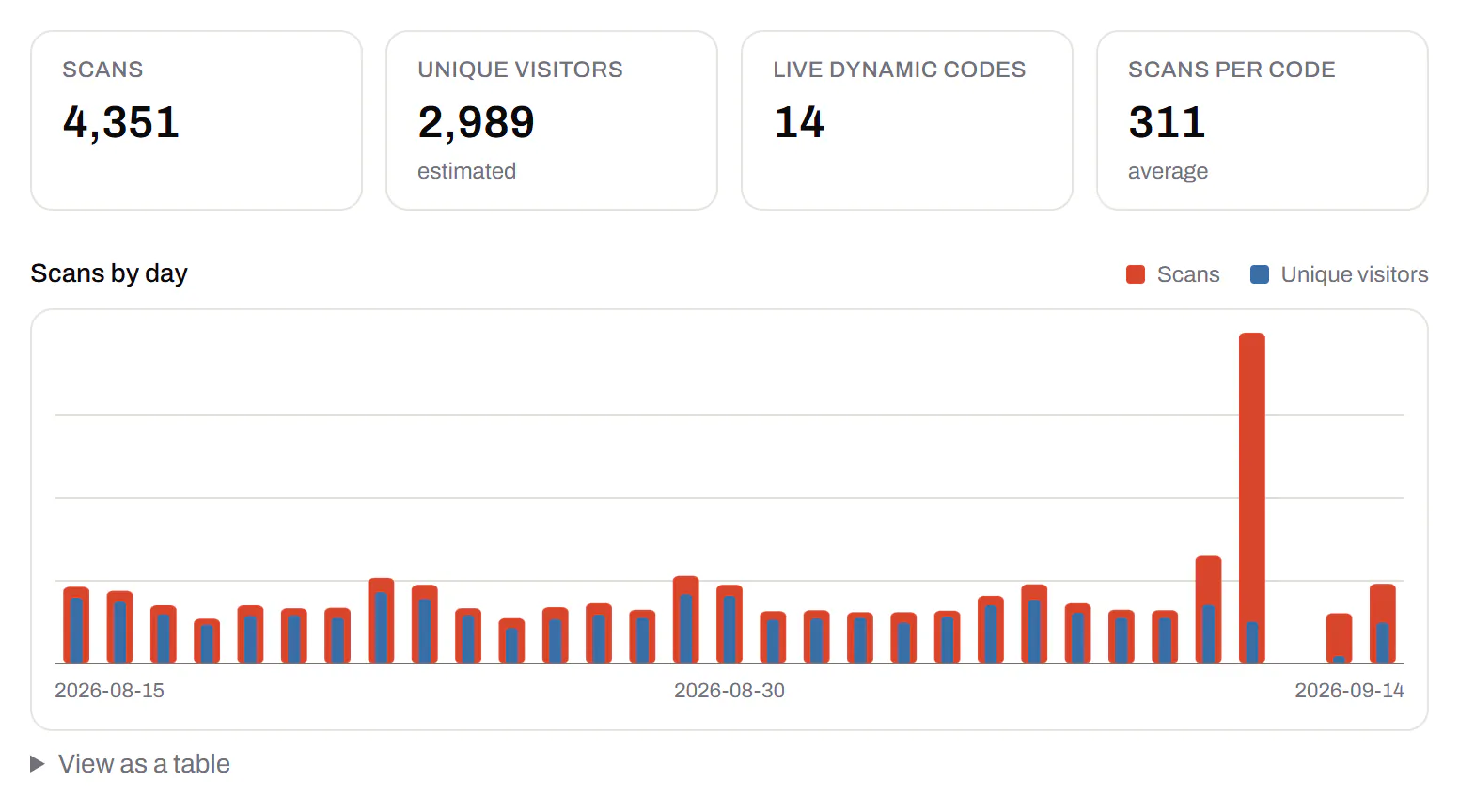
Scans by day, next to the day you put the sign up
Totals and a bar per day, so a Monday assembly or a handout at the door shows up as a spike. Free keeps 90 days of it.
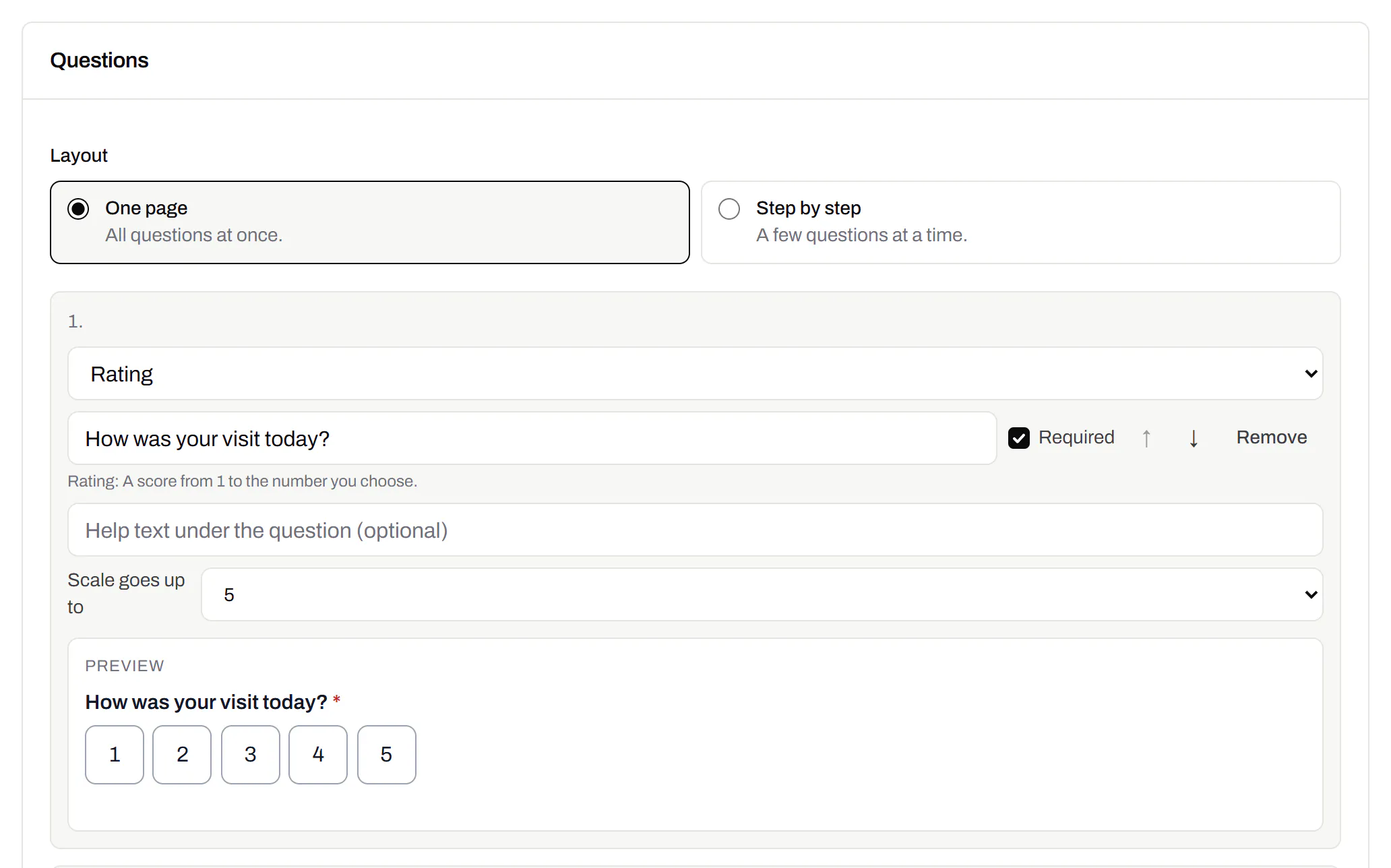
Or build the form here, and skip the second account
A QR Form is made in the same place as the code: 10 kinds of question, shown as one page or one question at a time, with a live preview of what the phone will show.
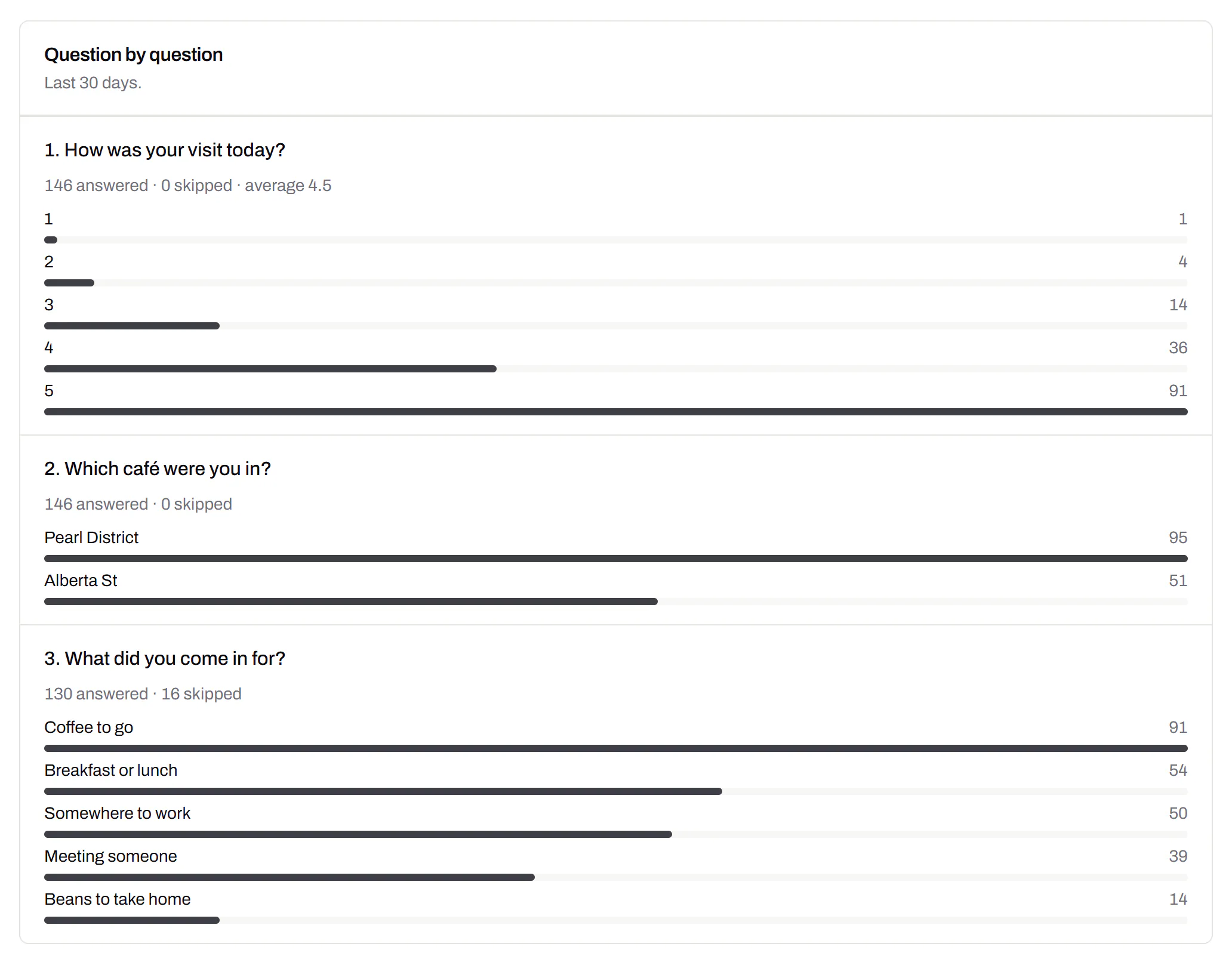
Answers added up question by question
Ratings averaged, choices counted, written answers listed. Every submission is screened for bots and rate limited first, and a CSV of the lot comes with Pro and Business.
Which Google link belongs on the code
Google gives a form more than one address, and only one of them is meant for the people answering it.
- Use the responder link. In the form, choose Send and then the link, and copy what Google offers there. Its own help calls this the responder link, and it also offers to shorten it.
- Not the address you are editing in. The link in your browser bar while you build the form ends in /edit. That one is for people who should be able to change the questions, so it must never go on a sign.
- Check it on a phone, signed out. Whether an answer needs a Google account, and whether it is limited to your school or company, are settings inside the form. A scan lands on the sign-in screen when they are on, which is easy to miss while you are logged in.
- Then make it dynamic. A code holding the Google link directly can never be changed. Save it here and the code holds a short link of ours instead, which is what can be pointed at a different form later.
Five minutes before the sign goes to print
Almost every dead form code fails for one of these reasons, and all five are cheaper to check now than to discover from a term’s worth of empty responses.
Scan your own proof
Use a phone that is not signed into your work account, from the PDF or the printed proof rather than the screen you designed it on. This catches the wrong link and an unreadable code in one go.
Send one real answer
Fill the form in yourself and check it lands where you expect. A form still in draft, or one whose responses were never wired to a sheet, looks identical from the outside.
Check it is open
A form that has stopped accepting responses shows a notice instead of questions. If yours closes on a date, decide now where the code should point afterwards.
Watch the restrictions
Sign-in requirements and organisation limits live in the form, not the code. A visitor without the right account sees a login screen, which you will never see yourself.
Say what it is beside the code
A line of text under the frame — what the form is for, and how long it takes — does more for the response rate than anything about the code itself.
Save it as dynamic first
The one thing that cannot be fixed later is a static code with the wrong address inside it. Saved to an account, every mistake above becomes an edit.
When the answers should just stay with the code
QR Forms are our own, made beside the codes rather than in another product. They are not Google Forms and they do not write to a spreadsheet in your Drive; the answers live here, where the scans are.
The questions
short answer, paragraph, email, phone, number, choose one, choose several, rating, date, checkbox. Up to thirty of them, required or optional, as one page or one at a time.
The answers
Counted and averaged per question as they arrive, with the written ones listed underneath. Mark them against correct answers and show a pass or fail when the form is a quiz.
What it costs
Forms are on every plan, Free included, where a published form is one of the 3 editable items. Answers can be pushed to your own systems with Business.
Where these codes usually end up
Three settings account for most of them, and each one changes what the form should ask and how often the link behind it moves.
A door, a noticeboard, a newsletter
Parents’ evening slots, a trip consent form, a club’s sign-up. The paper goes up once and is read for weeks by people standing still, and the form behind it is replaced every term — the case this whole page is built around.
A counter or a table card
A class booking at a gym, a warranty registration beside the till, a suggestion box that is not a box. Here the same form runs for months, so the code rarely moves; what changes is the question you get tired of reading.
The last slide of a talk
A room of people with phones already in their hands, for ten seconds. Keep the form to two questions, and point the code at the slides or the recording once the session is over, so the photograph somebody took of that slide still leads somewhere.
Check it at the source
- Google Docs Editors Help: send your form to people. Where the responder link lives, and the option to shorten it
Last reviewed , against the product as it works today.
What a form code costs
Free covers a class, a club or one event: 3 editable items, forms included, with no card. Starter is $12 a month for 100 codes, 365 days of history and a domain of your own on the link.
Free
Free
Unlimited static codes. Three editable ones that never expire.
- Unlimited static QR codes, forever
- 3 editable items in total — dynamic QR codes, QR Menus and QR Forms share them
- Dynamic codes never expire, and each comes with a short link
- Short links on their own, no QR code needed
3dynamic codes
Starter
$12/mo
For one business with codes out in the world.
- 5 QR Menus
- QR Forms
- Advanced tracking and analytics
- Live map of scans as they happen
100dynamic codes
Pro
Most chosen$39/mo
For agencies and teams running codes at scale.
- 50 QR Menus
- Unlimited analytics history
- 10 custom domains
- API access
600dynamic codes
Business
$99/mo
For organisations running codes across many brands.
- 400 QR Menus
- 50 custom domains
- Up to 25 team members and team management
- Up to 10 workspaces
2,000dynamic codes
Unlimited scans on every plan. Cancel online in two clicks. Compare every plan and feature
The rest of the toolbox
Open a row to see the screen and which plan has it.
Custom domains
Short links on your own domain, chosen code by code.Starter and up
Codes open go.yourbrand.com/menu rather than a link with our name in it, so the address under the code is yours. You add two DNS records and we check them. Then pick the domain for each code as you make it, or move a whole list of codes onto it at once.
Starter and up
QR codes on your own domain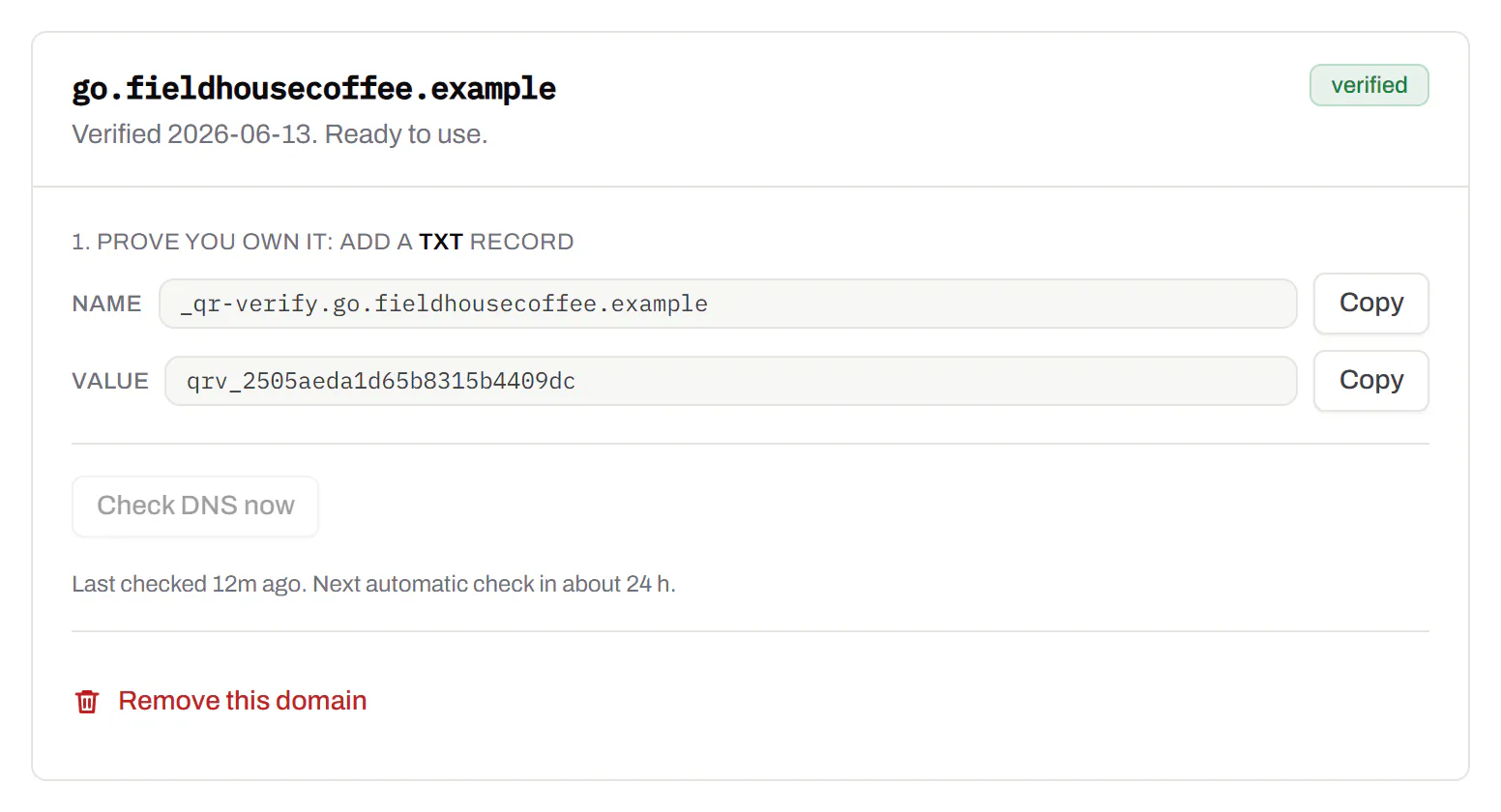
Bulk QR code generator
A spreadsheet in, one dynamic code per row out.Starter and up
Paste or upload a list of names and links, match the columns, and get a dynamic code for every row - one per table, stall, badge or product - each with its own scans and destination.
Starter and up
The bulk generator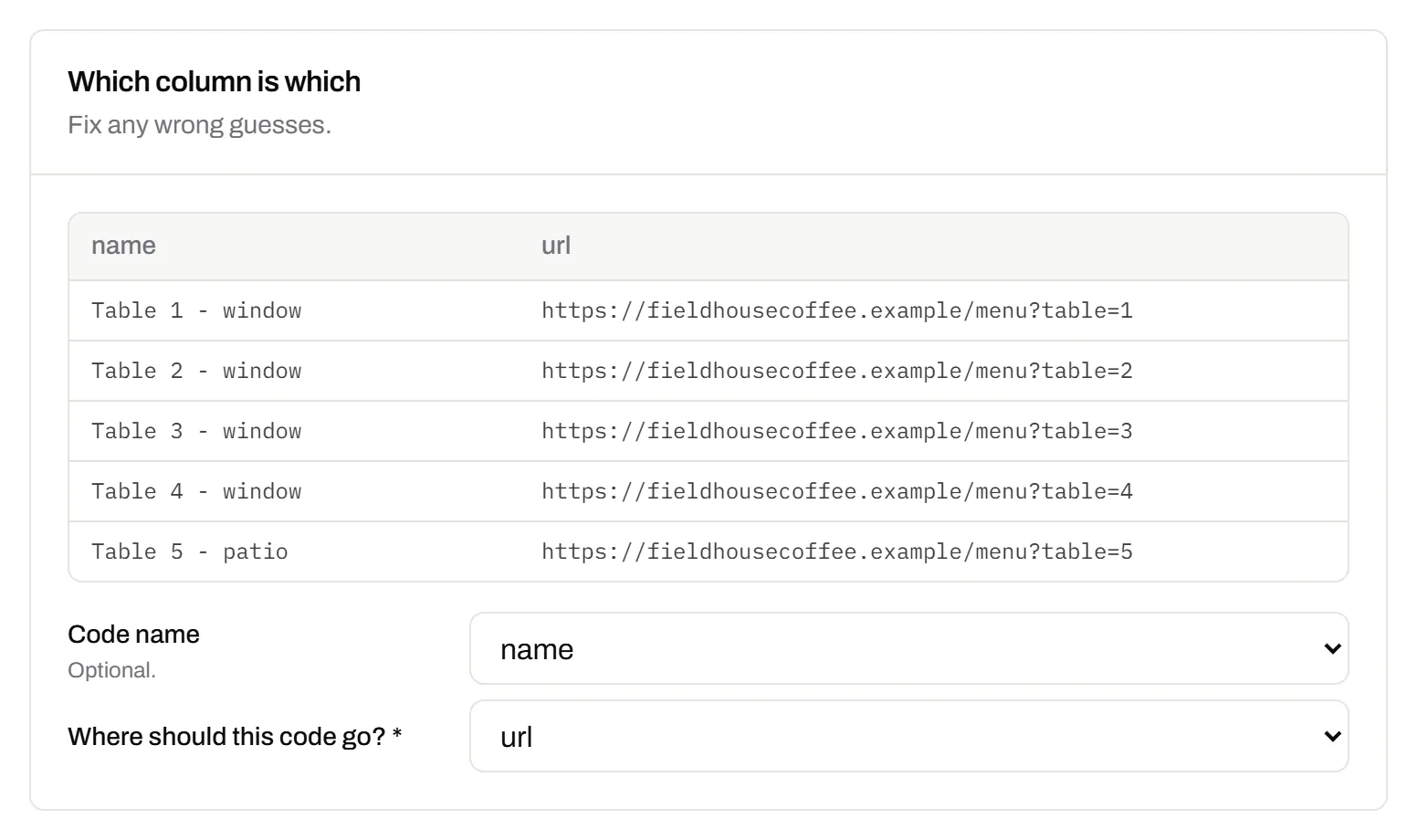
Change many codes at once
Tick the codes, then pause, tag, file or move them together.Pause and resume on every plan · folders and tags on Starter and up
Tick codes in the list, or pick every code with a tag, and pause or resume them, add or remove tags, move them to a folder or onto your own domain, or add campaign tags, in one go. The API does the same in one request.
Pause and resume on every plan · folders and tags on Starter and up
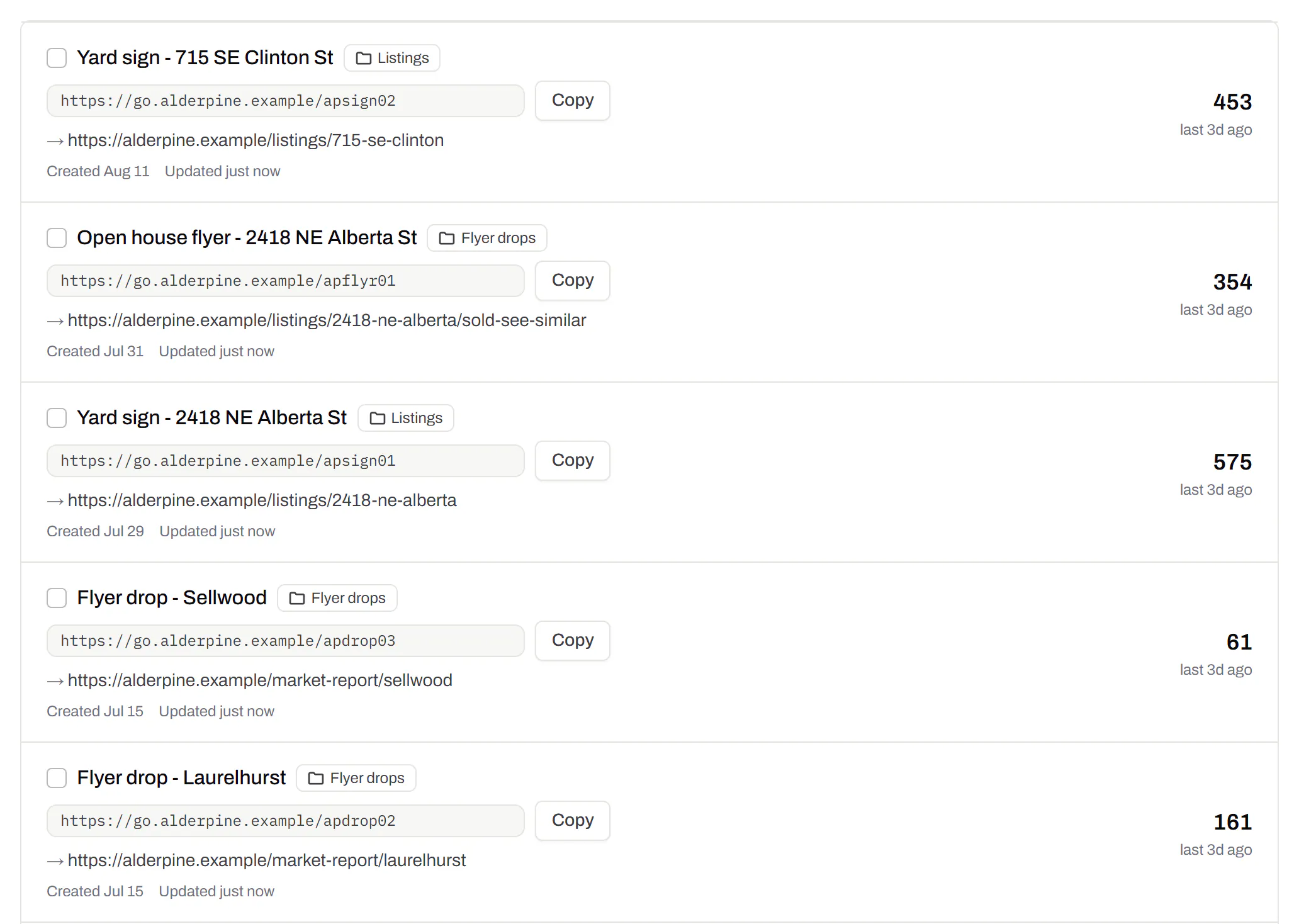
Short links, with your own ending
The link on its own, for a bio, an email or an ad.Every plan · custom endings on Business
Paste a link and get a short one you can change, route and count, with no QR code unless you want one. Every dynamic code already has its short link beside it, and a short link gets its QR code in one click - the same link, so clicks and scans count together. On Business you choose how the link ends, like /spring-menu, instead of random letters.
Every plan · custom endings on Business
The URL shortener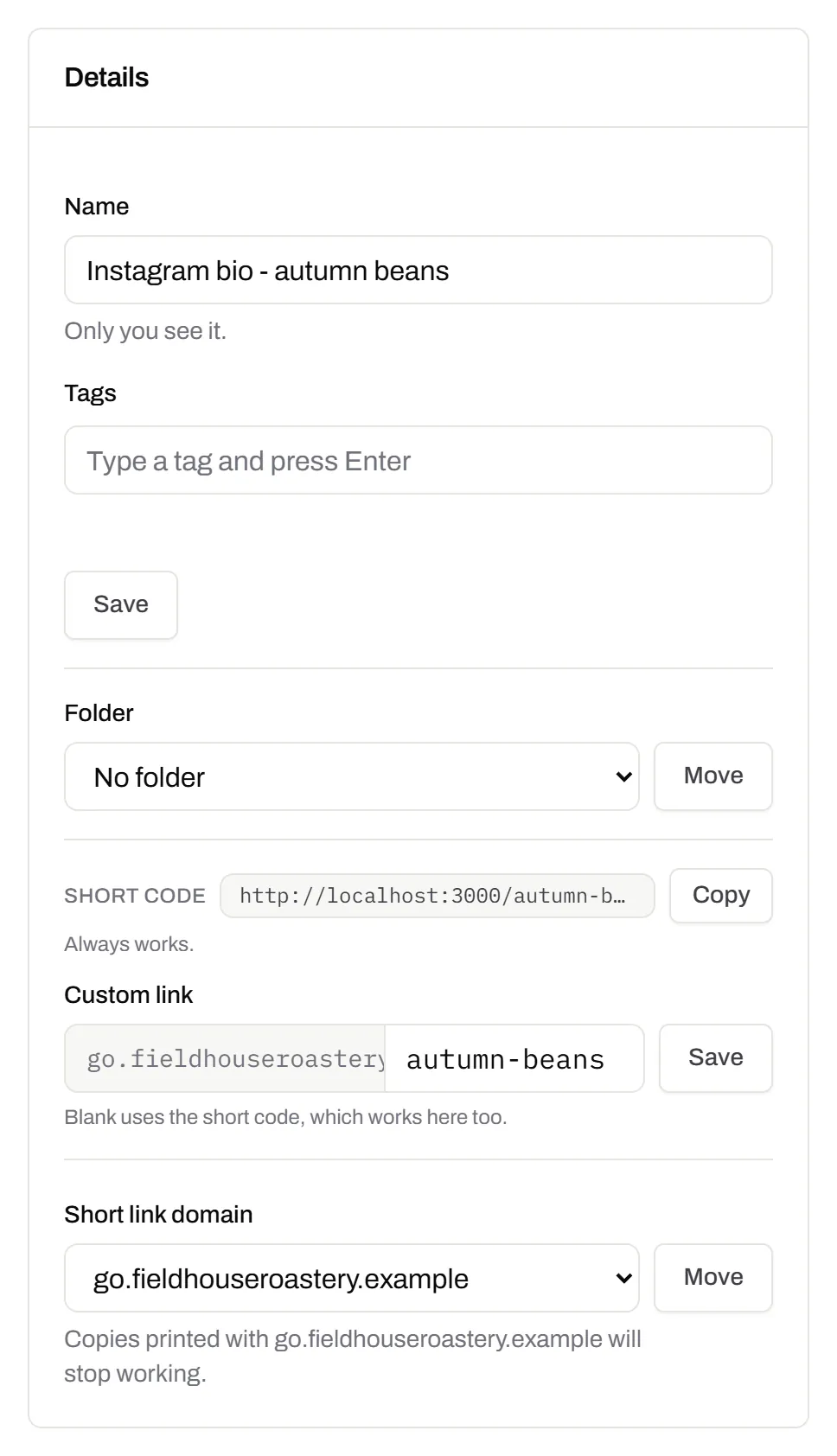
GS1 Digital Link for products
The retail code that carries your GTIN and still opens a web page.Every plan, Free included
Your domain and the GTIN from under the barcode, with batch, serial and dates if you want them, in the link format GS1 set for retail. A phone opens your page; the product data rides along in the address. The GTIN’s check digit is checked before anything is made.
Every plan, Free included
QR codes for packaging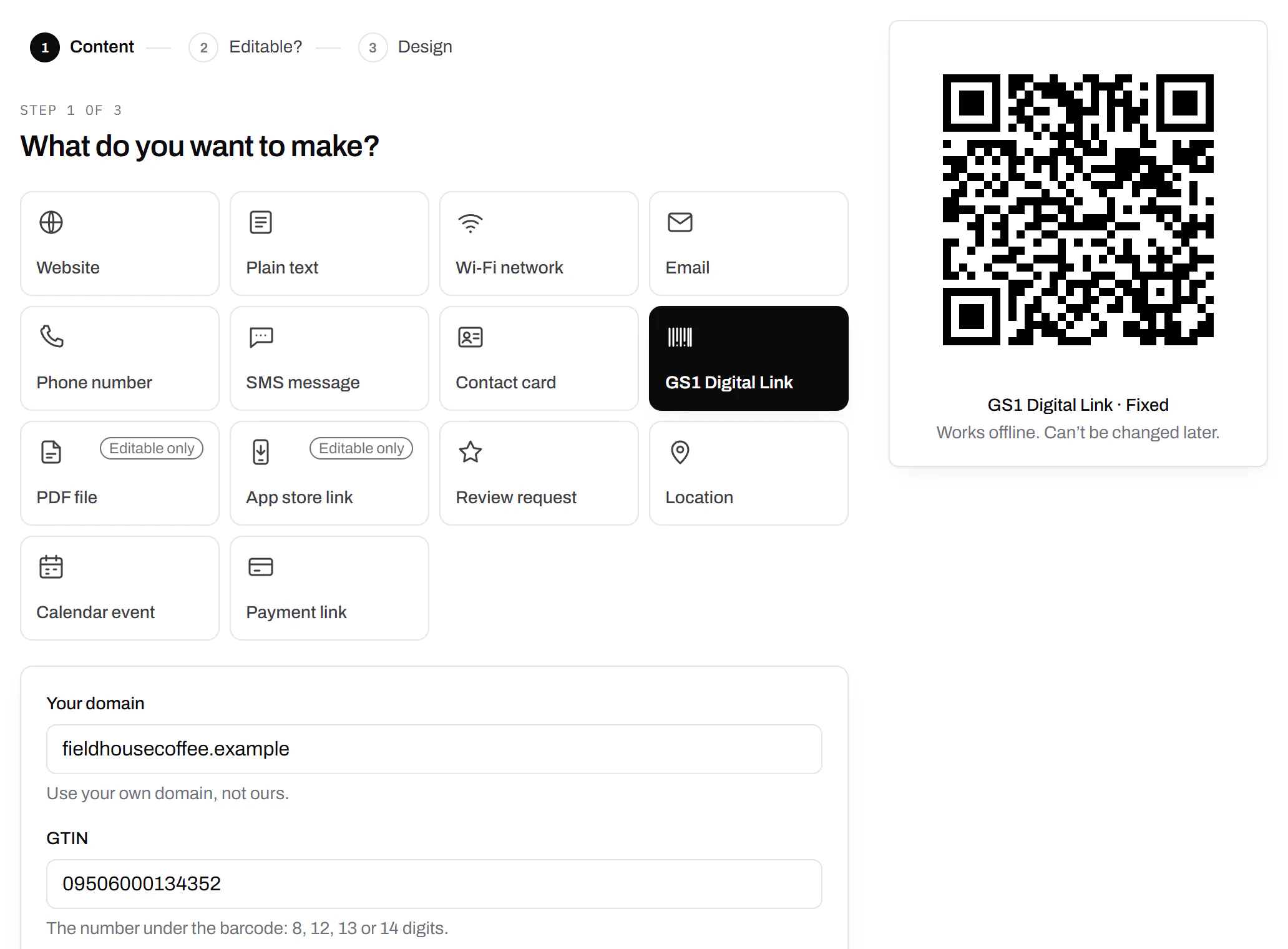
Wi-Fi, contact cards, email, phone and SMS
Networks, contacts, calendar dates and places, not only links.Every plan, Free included
A website, plain text, a Wi-Fi network, an email, a phone number, a text message, a contact card, a GS1 Digital Link, a PDF, a location, a calendar event and more. Most download free, with no account; the few marked “Editable only” need one.
Every plan, Free included
Contact card codes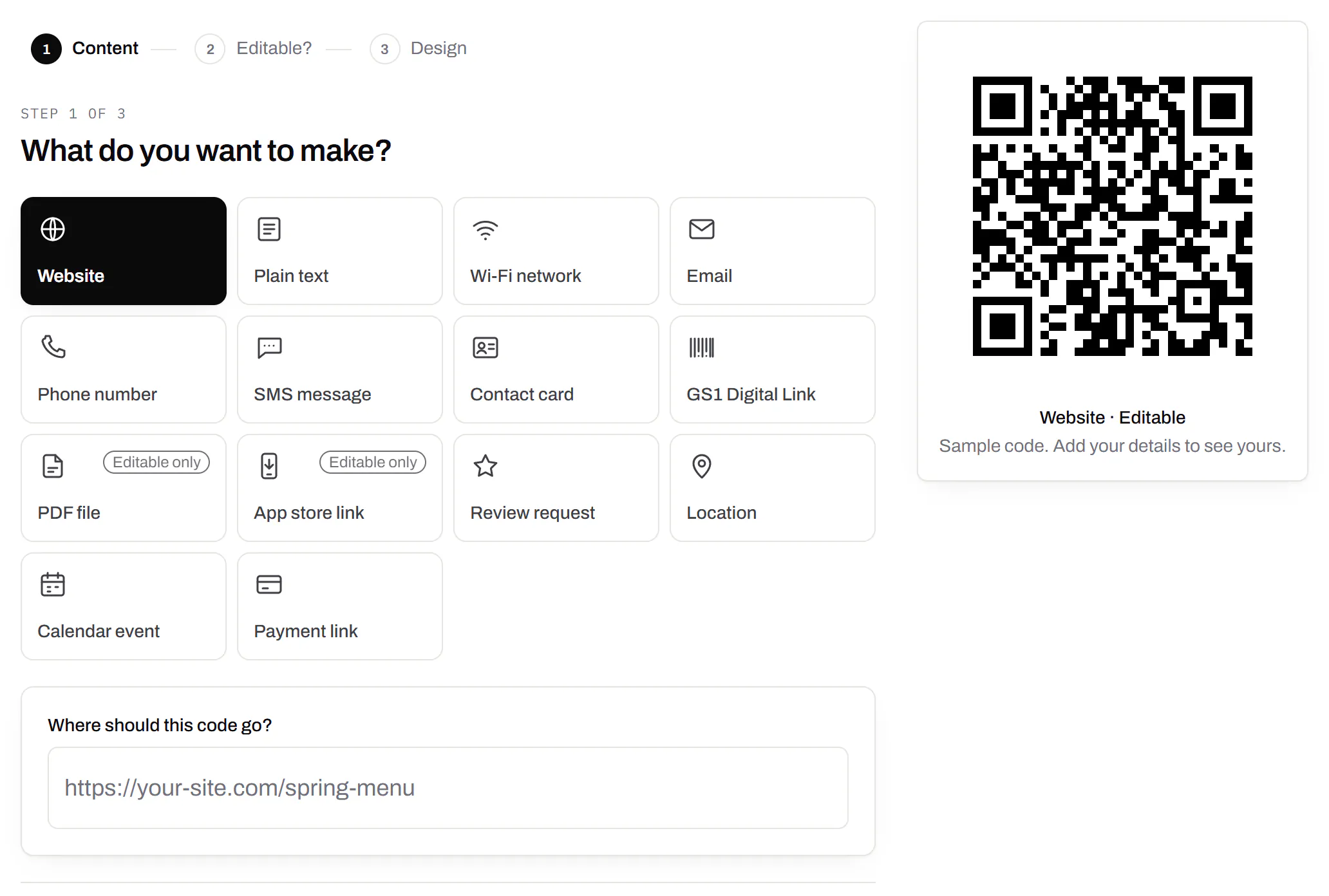
PDF codes you can update
Upload a PDF, print the code, swap the file later.Every plan, Free included
We host the file and the code opens it. Upload a new version and the same printed code opens that one, with the old file kept in its history in case you need it back.
Every plan, Free included
PDF to QR code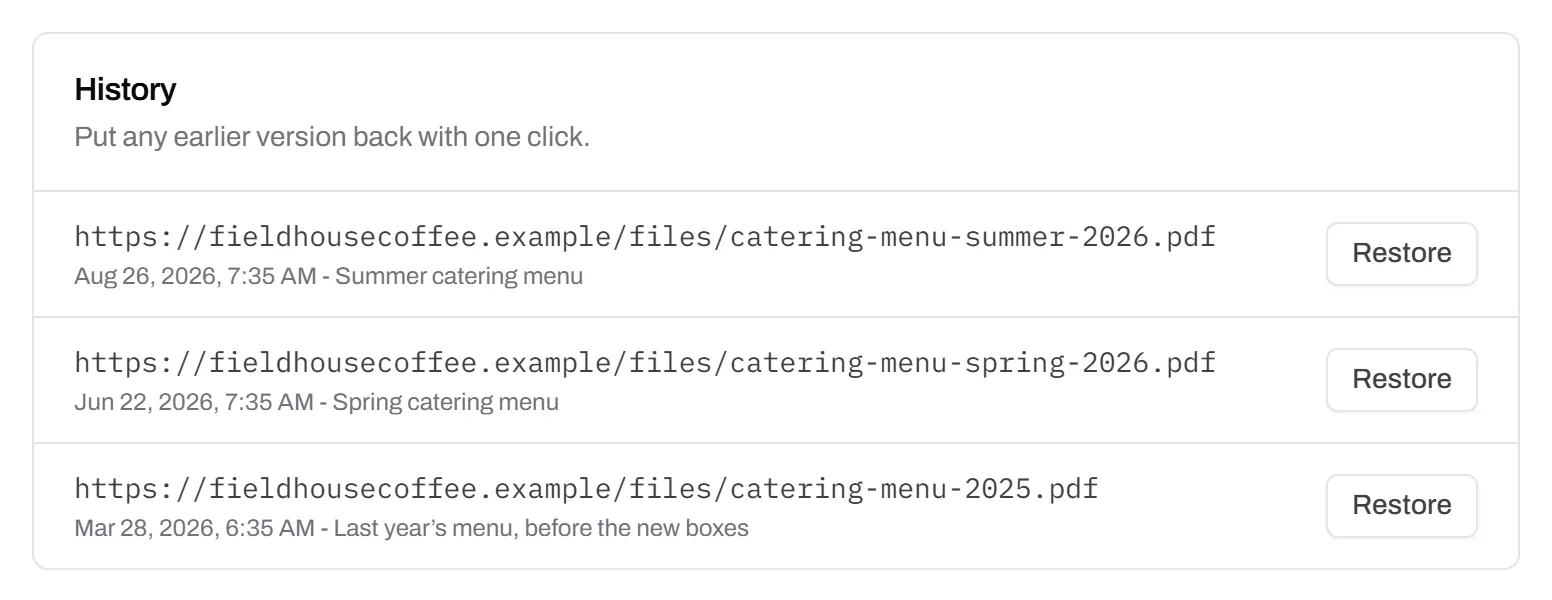
Your logo in the middle
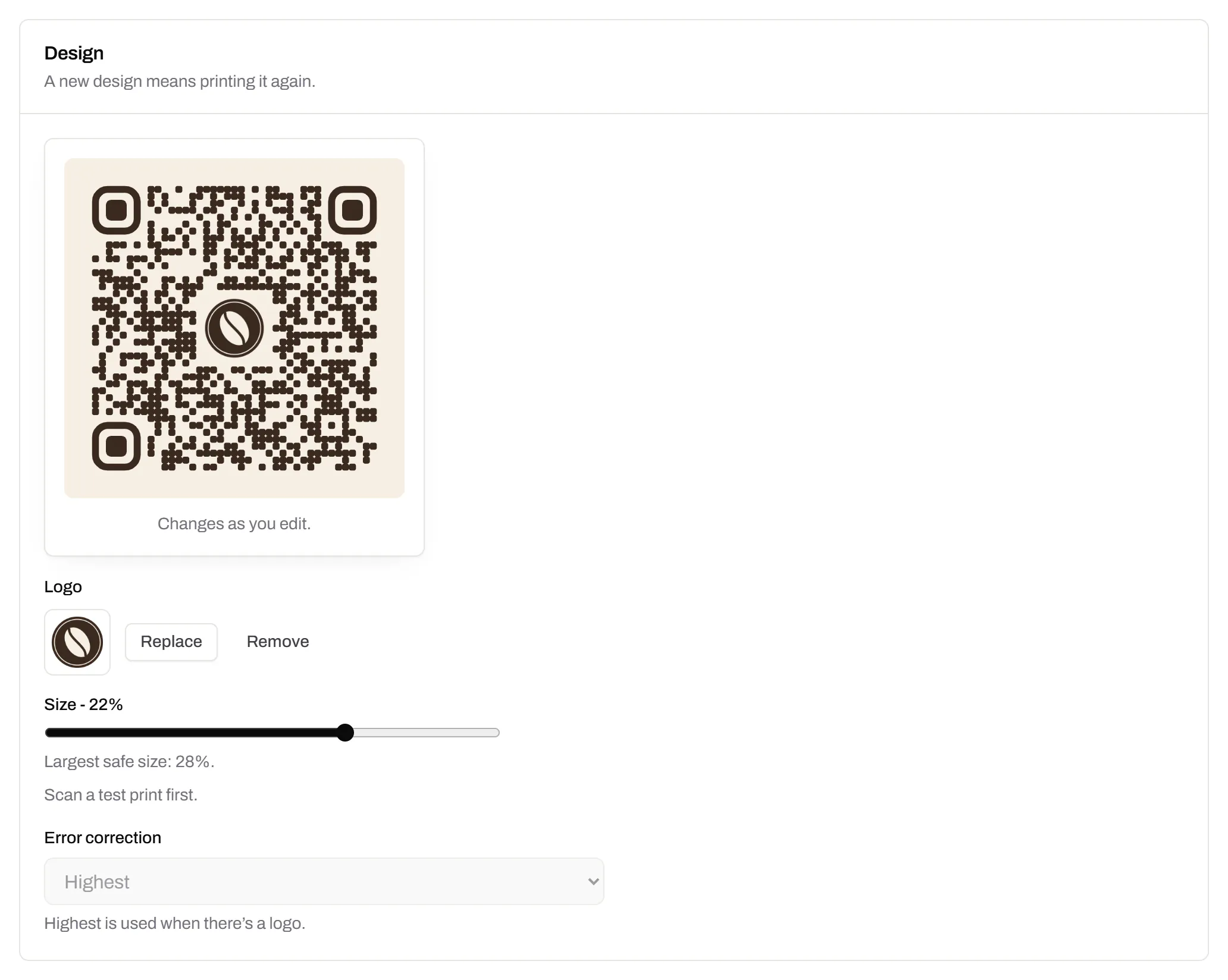
Upload any image; we size it so the code still scans.Every plan, Free included
PNG, JPEG, WebP or GIF, up to 15 MB - we shrink it ourselves, so nobody has to compress a file first. Error correction goes up to make room, and the logo is never allowed to cover more of the pattern than the code can lose.
Every plan, Free included
Print-ready downloads
PNG and SVG on every plan, and a PDF for the printer.PNG and SVG on every plan · PDF on Starter and up
PNG for screens and quick jobs, SVG for anything that gets scaled, and a print-ready PDF on Starter and up.
PNG and SVG on every plan · PDF on Starter and up
Folders and tags
Keep one location’s or one campaign’s codes together.Starter and up
Put codes in a folder per shop, listing or campaign and filter the list by it. Deleting a folder never deletes a code - they move to No folder, and you can undo it.
Starter and up
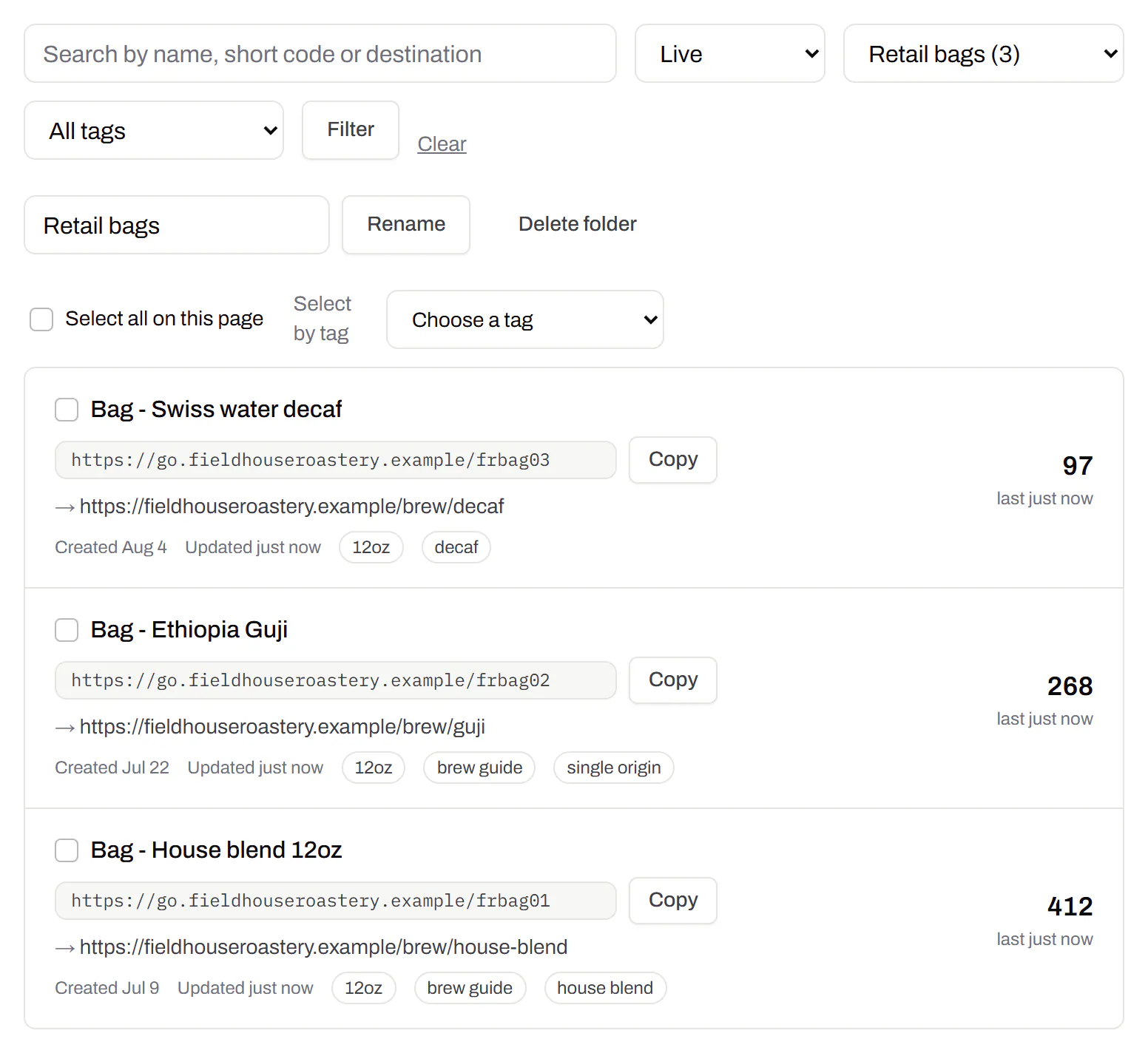
Campaign presets
Saved UTM parameters, so printed scans are not “direct”.Starter and up
A printed code arrives in your web analytics as direct traffic. A preset fills in source, medium and campaign in one click, so the flyer and the table tent show up as themselves.
Starter and up
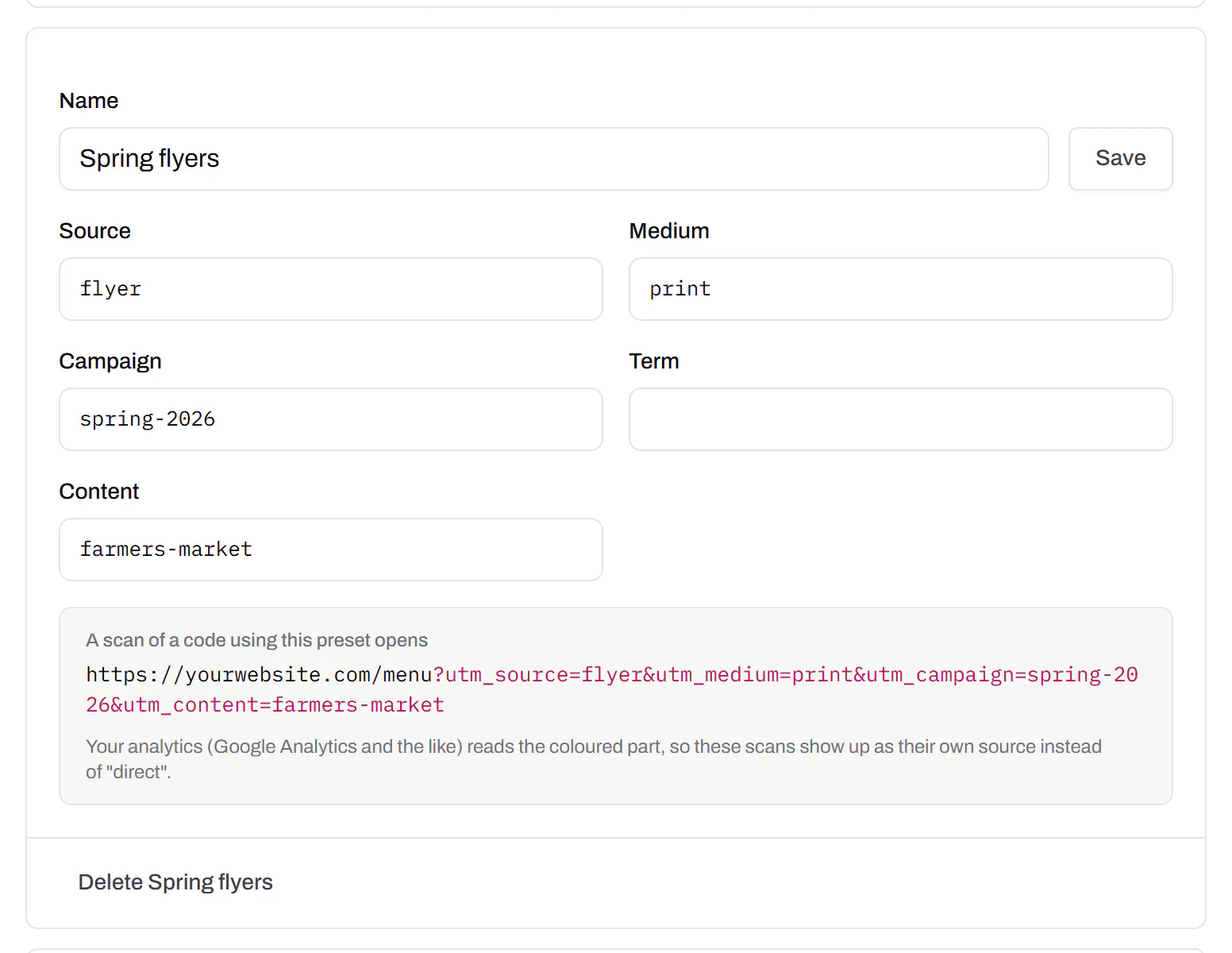
City-level scan locations
Which towns the scans came from, not only which countries.Pro and Business
Scans by city and region for each code, and towns on the live map. Coarse on purpose: the place the phone’s network reports, never a street or a precise position.
Pro and Business
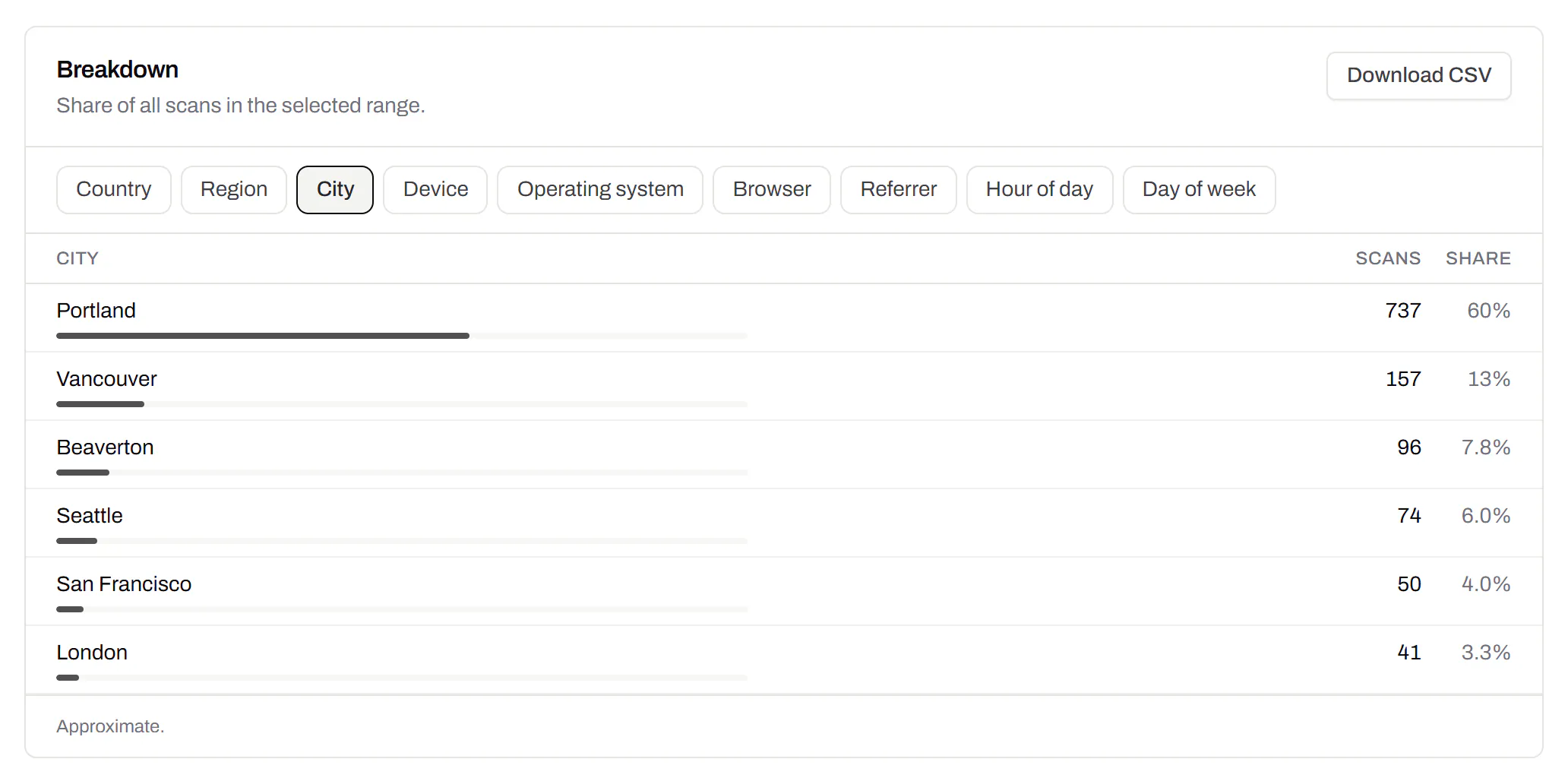
CSV export
Daily scans per code, in a spreadsheet.Pro and Business
Download scans and unique visitors by day for one code or all of them - with each code’s name and short link - as CSV for your own reports, or for whoever asked how the campaign did.
Pro and Business
Webhooks
Your server hears about every scan and every change.Business
Pick the events - a scan, a code made or changed, a form answered, a QR Menu edited - and give us an address. Each one arrives as a signed POST, retried if your server is down, and every delivery is listed with the response it got.
Business
The API and webhooks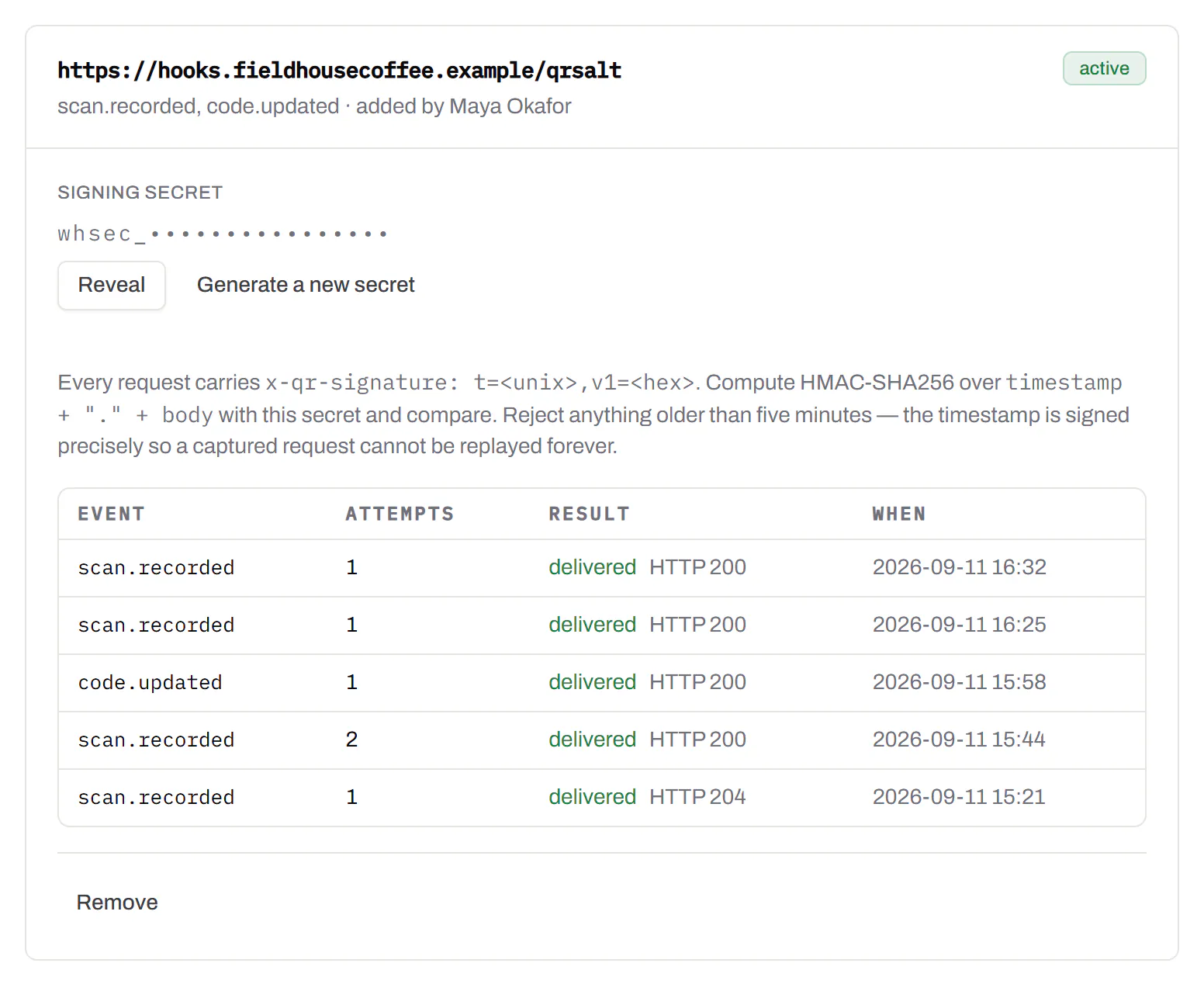
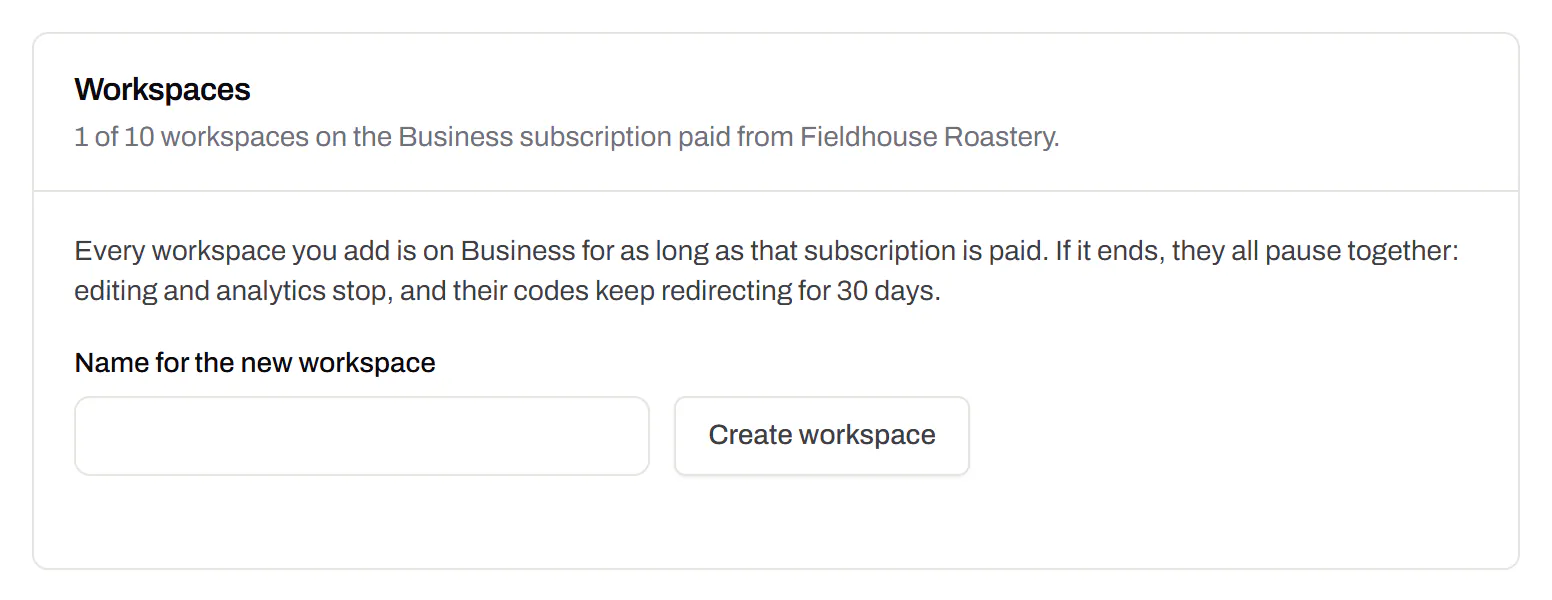
Separate workspaces
One subscription, a workspace per brand or client.Business
Each workspace has its own codes, team and analytics, so a client never sees another client’s. Up to 10 under one subscription.
Business
Priority email support
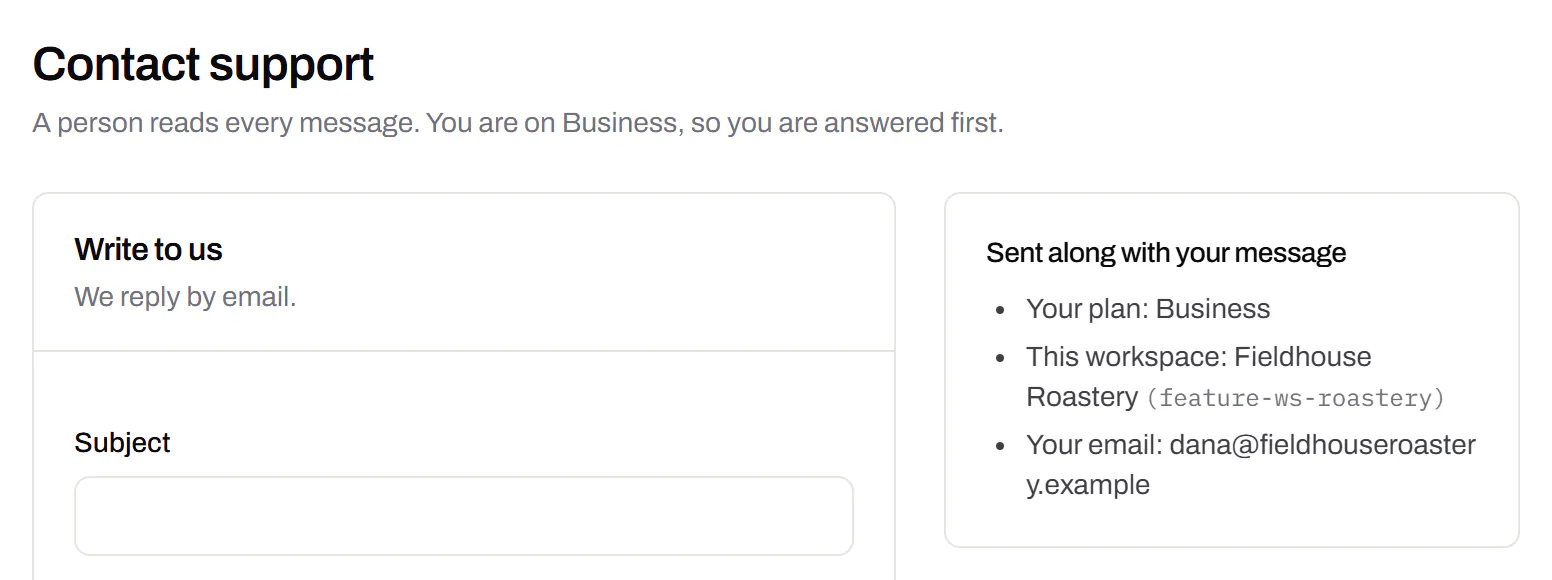
Paid plans’ emails are answered first.Starter and up
A person reads every message. On a paid plan yours is answered before free accounts’ - an order we keep, not a promised hour. Your plan and workspace go along with it, so nobody has to ask which account is yours.
Starter and up
Your data, to take or delete
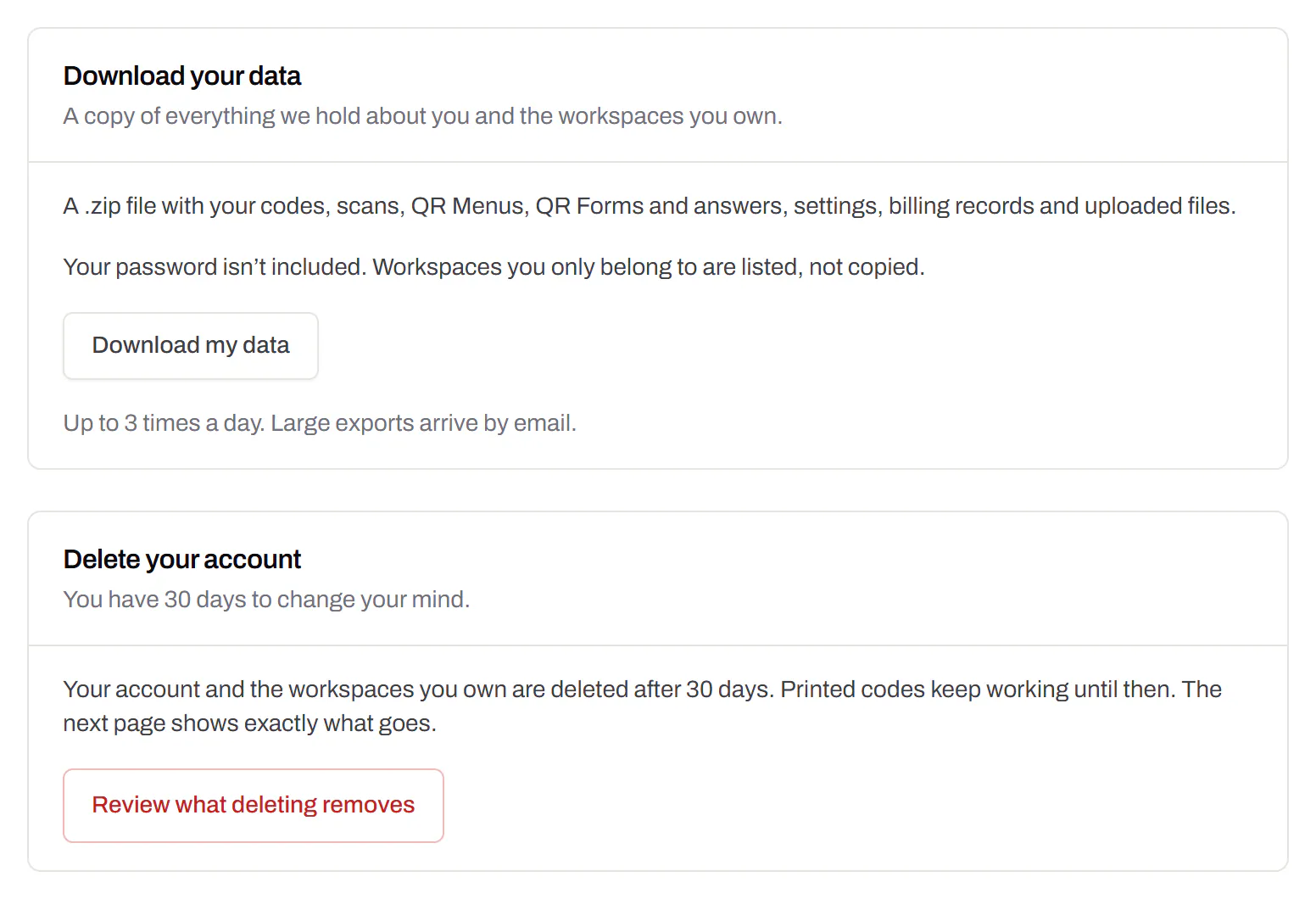
A full export any time, and deletion you can take back.Every plan, Free included
Download everything - codes, history, scans, form answers and the files you uploaded - as one .zip with spreadsheets inside. Deleting the account gives you 30 days to change your mind, and your printed codes keep working until then.
Every plan, Free included
An API for the codes you print
A REST API for your own code: make dynamic codes and short links, change where they go, render SVG, PNG or PDF, add your domains and change hundreds of codes in one request. No-code tools like Zapier, Make and n8n can call it too, with a plain HTTP step. The API comes with Pro and up, and every request carries your key.
Render a code · Pro and up
curl -o code.svg \
  -H "Authorization: Bearer $QRSALT_KEY" \
  "https://app.qrsalt.com/api/qr?data=https://example.com"
An SVG back, ready for a label, a template or an image tag.
Re-point a printed code · Pro and up
curl -X PATCH https://app.qrsalt.com/api/v1/codes/{id} \
  -H "Authorization: Bearer $QRSALT_KEY" \
  -H "content-type: application/json" \
  -d '{"destination":"https://example.com/winter"}'
The printed code opens the new page, and the old one is kept in its history. Keys can only ever touch their own workspace.
Change many codes at once · JavaScript
// Move a campaign's codes onto your own domain
await fetch('https://app.qrsalt.com/api/v1/codes/bulk', {
  method: 'POST',
  headers: {
    authorization: `Bearer ${process.env.QRSALT_KEY}`,
    'content-type': 'application/json',
  },
  body: JSON.stringify({ ids, action: 'domain', domain: 'go.example.com' }),
})
Pause, tag, file or move codes in one call. The answer lists what changed and what was skipped.
Google Form codes, answered
- How do I turn a Google Form into a QR code?
- Open the form, choose Send, copy the link it offers, and paste it above. Download the code for your sign or handout, or save it to an account first so the form behind it can be changed later.
- Which link should I use?
- The responder link from the Send panel, which is the one meant for people answering. The address you see while editing ends in /edit and lets anyone who opens it change your questions.
- Can I point the code at a different form next term?
- Yes, if you saved it as a dynamic code. Paste the new form’s link in its place and every printed copy follows from the next scan; the old link is kept in the code’s history.
- Will I know how many people scanned it?
- Every scan of a dynamic code is counted by day and by country, and from Starter and up you also see the device and where the scan came from. Google’s own response count then tells you how many of those scanners went through with it.
- Can one code send different people to different forms?
- Rules on the code can route by device, country, language and date on any plan, so a sign can open the English form for some scanners and another language for others, or switch to next week’s form on a chosen date. Weekly timetables come with Starter and up, and city rules and splits with Pro and Business.
- Do people need a Google account to answer?
- That is decided by the form’s own settings, not by the code: collecting email addresses or limiting the form to one organisation is what puts a sign-in screen in front of a scanner. Test the finished code on a phone that is signed out of Google.
- How is a QR Form different from a Google Form?
- A QR Form is built here, in the same account as the code, and its answers stay here rather than in a spreadsheet: 10 kinds of question, results added up per question, and submissions screened for bots. Forms are included on every plan, Free as well.
- Who ends up holding the answers?
- With a Google Form, Google does: replies go into your form and whatever sheet you linked, and none of it passes through us. All that is recorded here is that a scan happened, when, and roughly where from. Build the form here instead and the answers sit in this account rather than that one.
- Can the same code be used again next year?
- Yes, and it is the cheapest way to run the thing: copy the form, change the questions, then point the existing code at the copy. The sign that has been on the wall since last autumn starts filling the new sheet, and the link it used before stays in the code’s history with a button to put it back.
- What happens to the printed code if I cancel?
- It keeps opening the form for 30 days after the paid period, with an email before it stops, and then pauses on a page that explains rather than an error. Nothing is deleted, so paying again brings it back exactly as it was.
Collecting replies to an invitation rather than a form? Event QR codes cover RSVPs, the schedule and the photos on one code. Asking customers what they thought instead? See QR codes for reviews.