
Smart QR codes
One printed code, the right page for each scan: by time of day, place, device or language. Test a scan before you print, and change it any time after.
How it works
Cards checked from the top, then the code’s own link
Each card says who it catches and where they go. The first card that matches a scan decides; anything no card catches opens the code’s own link.
Build it
If the scan is … send them to …
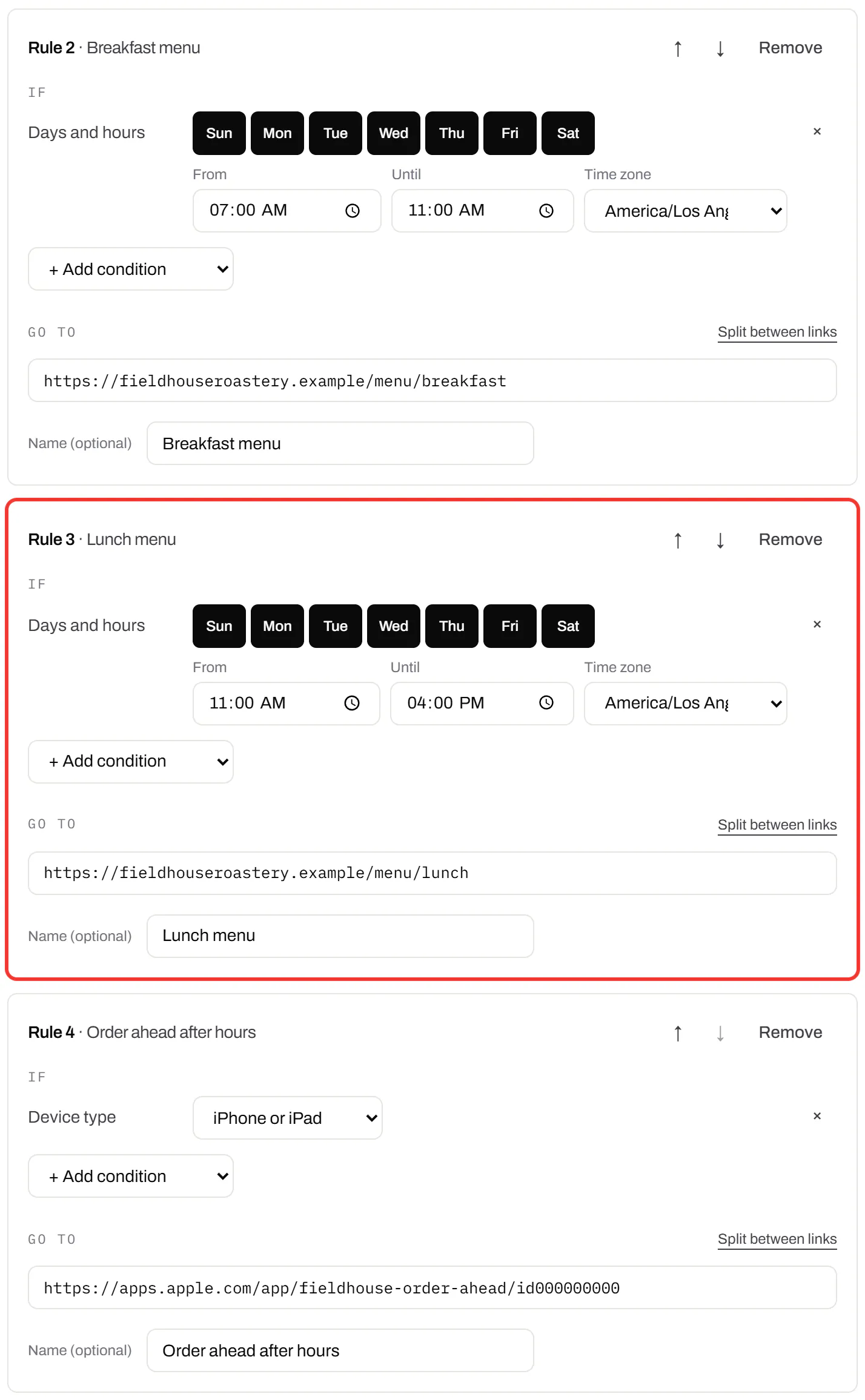
Add a condition, pick the link, move cards up and down. Each card reads back as a sentence, so what it catches is never a guess.
Test it
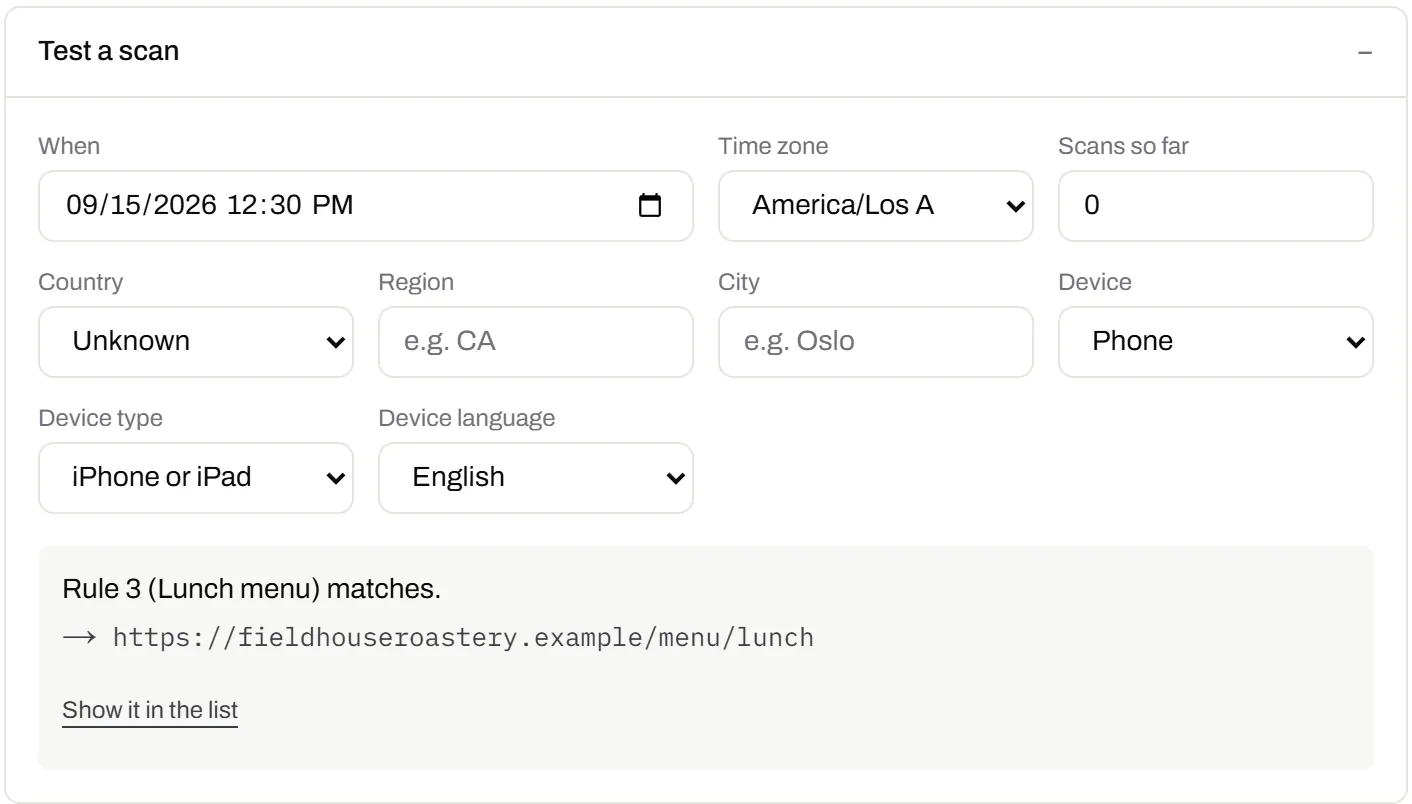
Test a scan before you print
Pick a place, a device, a language and a time in your own time zone, and see which card catches it and the link it opens. It runs exactly the check a real scan does.
Check it
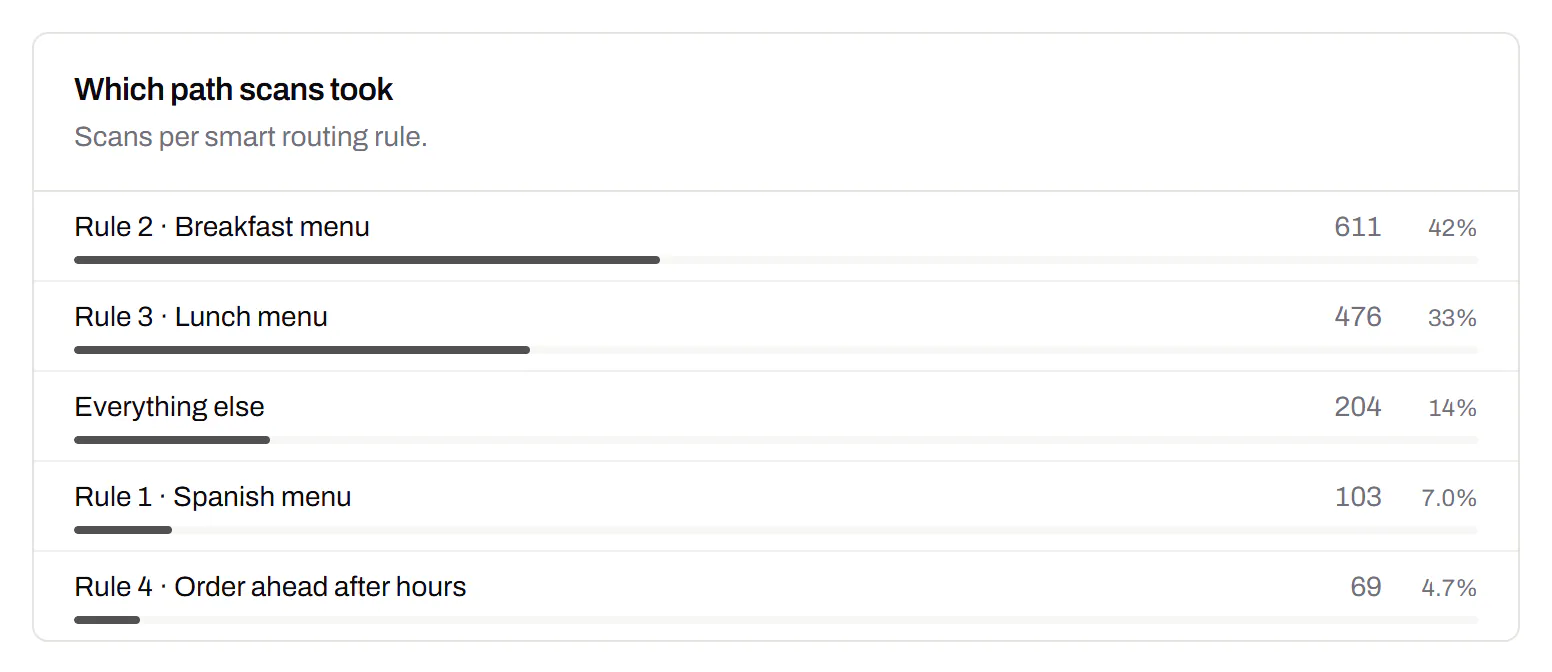
See which path each scan took
The code’s analytics count the scans each card caught, so a card that never fires shows up before anyone asks why.
Conditions
Redirect a QR code by time, location, device or language
Combine as many as a card needs: every condition on a card has to hold. Cards are checked in the order you set.
| Route by | For example | Plan |
|---|---|---|
| Device type | iPhones to the App Store, Android phones to Google Play | Every plan, Free included |
| Country | Scans in Canada to the Canadian shop | Every plan, Free included |
| Device language | Devices set to Spanish to the Spanish menu | Every plan, Free included |
| Dates | The spring promotion from 1 March until 1 April | Every plan, Free included |
| Days and hours | Breakfast 7–11, lunch 11–4, in your own time zone | Starter and up |
| Region and city | Scans in Austin to the Austin store’s page | Pro and Business |
| Scan count | The first 100 scans to a prize, everyone after to “sold out” | Pro and Business |
| A/B split | Half of scans to one landing page, half to another | Pro and Business |
Examples
What people route
Restaurants
The menu that fits the hour
One table tent opens the breakfast menu until eleven and the lunch menu after, in your time zone, with daylight saving handled.
Hotels and tourism
Every guest in their own language
Phones set to Spanish, German or Japanese open that version of the page. Everyone else gets the default.
Apps
The right store, automatically
iPhones to the App Store, Android phones to Google Play, computers to the website - from one printed code.
Packaging and retail
Each country’s own shop
The same box sold in five countries sends each scan to that country’s store, prices and returns policy.
Promotions
The first hundred win
The first hundred scans open the prize page; after that, a thank-you. Counted from your analytics, a few minutes behind.
Marketing
A/B test the printed flyer
Split scans between two landing pages in fixed shares, and see which path each scan took in the code’s analytics.
Honestly
Other QR tools can send iPhones to the App Store or switch a link on a date. What we add is all of these conditions on one code, checked in an order you choose, a test scan before you print, and a count of which path every scan took - on codes you have already printed, because routing lives behind the dynamic code’s short link.
Works for short links too
Routing belongs to the link, not the picture, so a short link with no QR code takes the same cards: one link in a bio or a newsletter that opens the right page for each click.
Pricing
Routing on every plan, more of it as you grow
Paid plans from $12/mo. Unlimited scans. Cancel online in two clicks.
Questions
Smart QR codes, answered
- What is a smart QR code?
- A dynamic QR code that sends different people to different pages. The printed pattern never changes; the link behind it decides where each scan goes, by time, place, device, language, how many scans there have been, or a split.
- Can I add smart routing to a code that is already printed?
- Yes, if it is a dynamic code. Routing lives behind the short link the code already carries, so you add or change it in the dashboard and the next scan follows it, within a minute. A static code cannot be routed: its content is inside the pattern and never reaches us.
- What happens to a scan that matches no card?
- It goes to the code’s own link. Cards are checked from the top and the first one that matches decides, so the last word is always the page you set for the code itself.
- How accurate is location?
- Country is reliable. Region and city come from the network the phone is on, so they are approximate and occasionally missing - and a scan whose city we cannot tell never matches a city card, it falls through to the next one.
- Does routing slow the scan down?
- No. The rules are read with the code in the same single lookup every scan already does, and checked in memory. There is no extra request between the camera and the page.
- Which plan do I need?
- Device, country, language and date routing are on every plan, Free included. Weekly schedules come with Starter and above; region and city, scan counts and A/B splits with Pro and above.
Related
New to editable codes? Start with what a dynamic QR code is. Running a restaurant? See QR codes for a menu.
Tuned defaults by job